Showing posts with label Herbert W Armstrong. Show all posts

Friday, September 5, 2025

Some Background On Hislop

I do apologize that today's post will be academic and boring. I never enjoy boring, but sometimes I find it useful.

Last year, I purchased a couple books by historian Ronald Hutton. I wanted to learn more about Halloween and Christmas, mistletoe and druids, and other such homely things long condemned in the extreme by Armstrongism. Turns out, as usual, we have been lied to by those busybody purveyors of paganism in the Church of God splinters (for example, read the posts "Samhain Was Not On October 31" and "Misinformed on Mistletoe").
Lately, I have been reading Hutton's "Blood and Mistletoe: The History of Druids in Britain". It is a difficult book, with long, tedious tracts of background information about authors since the 1600s who contributed to our [mis]understanding of Druids. It is packed with information. It was intentionally thorough, but its thorough nature makes it dry and laborious. By sheer force of will and natural stubbornness I am determined to finish it. I am only halfway through. Pray for me.
But it is not a bad book so far as it goes. Actually, it has some fantastic insights.

A curious thing occurred to me as I read it - this material applies to Alexander Hislop.

You might remember Alexander Hislop from such things as "The Two Babylons: Papal Worship Proved To Be the Worship of Nimrod And His Wife" - one of the most ridiculous pieces of anti-historical nonsense ever to waste paper and ink. A good amount of the garbage that came from Herbert Armstrong and "the most accurately informed historian in the world" Herman Hoeh was predicated on the toxic sludge left for us by Hislop.

Hislop was a Presbyterian minister who joined the Free Church of Scotland in 1843. Presbyterians and all Protestants are considered "daughters of the harlot church" (re. REV. 17: 5) by Armstrongism, and condemned. This one man gets a pass for purely utilitarian reasons. Notice that date there - 1843. What else was happening then? Why William Miller's Great Disappointment, of course. The 1800s were bad years for Christendom.
Hislop did consider the Catholic Church a harlot, but did not associate himself with being a daughter of it. His entire book was a condemnation of the Roman Catholic system. This was par for the course in the early 1800s. Hislop was not by any means alone. He was a product of his time. That is what Ronald Hutton's book makes clear.

In Hutton's book, he reviews several historians beginning in the 1600s who were instrumental in the study of the Druids of the British Isles. Hutton walks us through who these authors were, what their lives were like, who they knew, who inspired them, and other such details so that we can understand why they wrote what they did. Patterns emerge.

The authors of the 1600s were like babes in the woods. They had nothing to go on but ancient writers like Pliny and Julius Caesar, a scant few stone henges sticking out of the ground, some folklore, and the Bible. Every missing detail was filled in by pure imagination. But that wasn't abnormal in those days. That's how most everyone did most everything. It's not like the science of archeology was there to guide them.
The authors of the 1700s had the exact same resources, now colored by the fancies of earlier writers. Their main take was that the Druids were isolated and therefore kept a more pure form of the one true ancient religion of Noah's day. They lacked the divine revelation given to the Hebrews, but otherwise kept Noah's religion better than anyone else had. There was a sense of national pride here. That Britannia could be the home of such noble savages was uplifting to the national spirit. It was a tool to unify the United Kingdom yet provide a way to remain attached to old customs of Saxony, Scotland, Ireland, and Wales before they disappeared. It was also a poke in the eye of the Catholics. After Queen Elizabeth I solidified England as Protestant, and after the civil war "of three nations", the divide between Protestants and Catholics was growing. Anything and everything was fair game to use against Catholicism.
The authors of the 1800s yet had the same resources, yet again colored by earlier writers, but the Industrial Revolution and contact with the Far East afforded by the British Empire was changing their view of the Druids. In Wales and Ireland, the Druids maintained their positive perception, but in England, rather than a pure and proud people, the Druids were seen as murderous and thoroughly corrupt. The Druids were no better than the easterners who practiced head hunting, human sacrifice, and other various cruelties of rank paganism. These points were all used against Catholicism, but they had now begun to be used against Protestantism as well. Any organized and influential ministry was becoming fair game.

Bear in mind, none of these people knew what the Druids actually did outside of the details left by the Romans. Few of them actually trusted the Romans. Roman renditions were more likely propaganda than they were honest telling of wrote fact. We still today know barely more than they did and we still use mostly the same resources. We might know the stone henges predated the Druids by quite some time, but we don't know what the Druids did with them, if anything. We still have people who fill in the blanks with wild imagination. And we still use what we find in games of religious one-upmanship.
The more things change....

But here is what I've been driving at --
You might see in here the seeds of Alexander Hislop's approach. For example, Catholic bashing, an ancient single religion, beliefs and practices from the Middle East coming to Britain, precise details conjured from imagination built upon scant facts, and etc. You might also see in here the seeds of ideas such as we find in "The United States and Britain In Propehcy" - a book Herbert Armstrong plagiarized from J. H. Allen's "Judah's Scepter and Joseph's Birthright". (We have articles on this. Go to the Categories page and look for British-Israelism.)

The notion that Alexander Hislop knew what he was talking is laughable. Babylon wasn't even unearthed yet and the language barely translated by the time he finished his book. Serious scholars were calling him out from the very beginning. He had very little facts to rely on and none of his claims line up with what we have learned since. Why would he do this? Why would he make things up whole cloth like this? Why would he fill entire books with little other than fanciful imaginations?
Because that's what most people did back then! They filled in details with imagination and attacked the Catholics with it. Hislop is a product of his time.

And why would Armstrongism give him a pass to this day; to this very minute ignoring everything that has been proven over and over and over again to be false? Because it's convenient.
God's truth? Not even close.

Let this be a lesson to use only the most reliable sources and to employ older material only with utmost caution.

I don't condemn Hislop. If we were born then and there, we'd probably be doing much the same things. I don't like this silly notion of moral superiority based on what time we live in. He wasn't evil. He did what he thought was right given what resources he had. It's just that the result of his works are entirely destructive. It's the works, not the man, that I criticize here. He is almost as much a victim of this as we are. His works should have been forgotten but they were abused by charlatans and false prophets.
Herbert Armstrong, on the other hand, knew good and well what he was doing and was a liar and a thief on purpose. Knowingly. Willfully. I will not extend him this same courtesy. To him, or to the present-day leadership in the COGs who have every resource at their fingertips to right past wrongs but refuse because it's too convenient to their bank accounts.


************

It is important that you understand; Everything on this blog is based on the current understanding of each author. Never take anyone's word for it, always prove it for yourself, it is your responsibility. You cannot ride someone else's coattail into the Kingdom. ; )

Acts 17:11

************

Wednesday, September 25, 2024

Just What Do You Mean ... Gospel?

Euangelizo. It's Greek. Sound strangely familiar? It is a verb, a conjugation of euangelion. Euangelion is a message or an announcement of something positive. Good news. From the Greek eu, meaning good, and angellein, meaning message. The Hebrew equivalent is the word bawsar. Euangelion in Greek becomes evangelion in Latin. It takes a turn when translated into English. In Old English, it is god, meaning good, and spel, meaning story. The -d was dropped in the 13th century. You know where I am going with this. Euangelion is Greek for gospel.

An evangelist is a person who spreads the gospel. Why we have evangelist instead of gospelist is a mystery to me.
On a related note, angellein is the act of delivering an announcement (just like euangelizo is the act of delivering good news), but angelos is a messenger that does the delivering. That's angelos, as in angel. Angels deliver messages.

Enough with the interesting trivia. But I've done that for a reason.

Today's post is about gospel. I want to explore what an euangelion is. What does the word mean? I think knowing what a gospel is will help us better know what the Gospel is.

THE GOOD NEWS ACCORDING TO HERBERT

There are lots of messages of good news in the world, but only one we call "the Gospel", with a capital G. People think all sorts of things about what the Gospel is. The Gospel usually contains these three elements:

  1. A message about who Jesus is. He is the promised Messiah; the Son of God made flesh.
  2. The message Jesus preached. He preached the Kingdom of God and forgiveness of sins.
  3. A message about what Jesus accomplished. On the cross He atoned for our sins, saved us all from death, ushered in the New Covenant. By His resurrection He was shown to be who He claimed to be.
That isn't a comprehensive list, but it seems reasonable enough.

In Armstrongism, however, the Gospel is not about Jesus, and has little if anything to do with what He accomplished at His first coming, but is ultimately about prophecy and law (especially the Sabbath) via the "soon-coming Kingdom of God". Being an Adventist off-shoot, it is no great surprise Armstrongism spends quite a bit of time on Sabbath and prophecy. That is the Adventist way. The Gospel, they say, is a message Jesus preached, not a message about Jesus.

"The Gospel of Jesus Christ is NOT man's gospel ABOUT THE PERSON of Christ. It is CHRIST'S Gospel - the Gospel Jesus PREACHED - the Gospel God SENT by Him, and therefore it is also called, in Scripture, the Gospel of God. The Gospel of God is God's GOSPEL - His Message - His Good News which He sent by Jesus."
-Herbert Armstrong, "What Is The True Gospel?", p. 6, 1972

Jesus is not the good news (euangelion), only the bringer of good news (angelos). The good news (euangelion) is the future Kingdom of God. In other words, prophecy and law. 

To spell this out so unfamiliar people can understand - the good news is that Jesus will return at some unknown point in the far future, bringing to the whole world the Old Covenant law that the Jews already had for thousands of years, and those conditions will usher in an eternity of peace.

An eternity of peace is good news! I wouldn't argue against that.
It's the rest of it that I have trouble with. 

There are at least two instances of sleight of hand going on with Armstrong's version of the Gospel. 

In the first, what Armstrong did was he claimed the Gospel is only what Jesus said, not what anyone or anything else said. What anyone else said is "man's gospel".
In this, Armstrong split the Gospel from having all three parts that I mentioned at the start of this article into a message of one of those parts only. There is only one Gospel, the Kingdom is the part Jesus gave, and the rest are man's false gospel, so just ignore those other parts. I disagree.

When the Apostles preached the Gospel, they did not preach solely on what was going to happen in their far future, they primarily focused on what Jesus did and how it affected the people alive in their own time. Were the Apostles and Prophets "mere men"? Is Jesus the only one who preached the Gospel? Did the Apostles and Prophets preach a different Gospel? Were those things they wrote not inspired by God? Right on page 5 of the booklet it admits the Gospel came from God the Father through men. Is their message really just "man's gospel" then?  When Paul described the Gospel he preached, he didn't use the phrase "Kingdom of God" at all, so was Paul's message from "mere men"? When Jesus preached, He said the Kingdom of God was at hand (MAR. 1: 14), effectively making it one of His own accomplishments, so was He preaching a false Gospel because even He didn't limit the Kingdom to His second coming?

We will get to man's gospel later, but I cannot accept that unless it came from Jesus' mouth, and it was about the future and the law, then it's man's gospel. It genuinely sounds contrived to me, like this claim was specifically crafted to get a predetermined conclusion out of the text. Prophecy and law were Armstrong's message. Therefore, we see it's God's word when Armstrong thinks he can benefit from it, but it's man's word when he doesn't. He wants to have it both ways.

The second sleight of hand is that all those different messages are really just the Kingdom of God anyway. So, it's not that you ignore them, you just blend them into the one and only true message.

Jesus preached grace and peace and healing and salvation to the people of His day and to us. Notice closely, on page 3, Armstrong says people who bring those messages are false preachers. Yet, on page 8 of his book, Armstrong quotes the phrase "Gospel of GRACE" as if it is legitimate, and even refers to the New Covenant as a time of grace. He even has grace in all caps. On page 5, he quotes Peter as saying Jesus preached peace. On page 11, he quotes Jesus commanding His disciples to heal the sick. On page 8, he calls it the "Gospel of SALVATION". Again in all caps. So, which is it, really? Here it's false; there it's true. Are they false gospels, man's gospels, or part of the one true Gospel of the Kingdom?
It's all of the above! ...depending on what he wants to get from it.

In Armstrong's booklet on the true Gospel, there is no mention of the cross. At all. The words cross and crucifixion do not appear once. No mention of how Jesus fulfilled the law and the prophets at that time. And the only resurrection mentioned is man's. So, not a word about Jesus' death and resurrection. The single most important event in the history of creation, central to the Gospel, the central thing Paul preached, merits no mention whatsoever.
It does mention Covenant, and how Jesus was Malachi's messenger of the Covenant, but nothing about how Jesus accomplished that at His first coming. We know the New Covenant is now. Jesus initiated that at His death. So, if Malachi says Jesus was the messenger of the Covenant, then Jesus was not exclusively a messenger of the far future Kingdom. Is the message of the Covenant a true Gospel, then? Oh, that would be an accomplishment and we can't have that, plus it's now rather than at His second coming, so it's doubly verboten. Instead, he immediately takes that ball and runs it in the direction of ... prophecy and law. Indeed, the underlying theme of the entire booklet is prophecy and law. Because of course it is. Prophecy and law were Armstrong's message, so he made the Gospel to be prophecy and law, even when it wasn't.

In your mind's eye, imagine yourself a faithful Jew in the first century. You are a child of Abraham, inheritor of the Covenant, keeper of the Commandments, oppressed by Rome, waiting for the re-gathering of the diaspora. You can almost imagine yourself transported back to that ancient place and time, listening intently to the fantastic message:

"Good news, everyone! I will be back in a few thousand years. In the meantime, practice your Sabbath-ing just like you have been since Sinai."
Somewhat less inspiring "news" than advertised.
I don't see a message like that inspiring many Jews to convert. Although, a message like that would explain why Armstrongists believe their ideological ancestors spent the past 2,000 years as tiny groups holed up in the Alps (which didn't really happen).

Fore more on how there is another Gospel in Armstrongism, I recommend Martha's article "A Different Gospel".

Speaking of imagining yourself as an ancient citizen of Jesus' day, what would the people in that place and time understand the word "euangelion" to mean? I want to inspect what the word euangelion (gospel) would have meant to the original audience of the message. It wasn't some made up nonsense word that the Apostles invented to describe this new thing they preached. The word already existed. But what did euangelion mean? Maybe if we investigate what a gospel even is, we will see if the Armstrongist view holds up.

GOOD OLD NEWS

A common misconception is that the first time you are going to find euangelion in the Bible is in Matthew. But did you know that euangelion is found in the Old Testament, too? If you read the Septuagint, which is the Greek translation of the Old Testament, you will see euangelion in some telling places. Or bawsar, if you read the Masoretic in Hebrew.

For example, you remember in Luke 4: 16-19, when Jesus read Isaiah 61: 1-2a in the synagogue. "Good tidings" in Isaiah is translated from euangelion/bawsar. Some translations even render it "gospel" in Luke 4. It is a very interesting list of things Jesus came to preach. Gospel, healing, liberty (mentioned twice).

Here is another one:

(ISA. 40: 9) O Zion, you who bring good tidings [euangelizo], get up into the high mountain; O Jerusalem, you who bring good tidings [euangelizo], lift up your voice with strength, lift it up, be not afraid; say to the cities of Judah, “Behold your God!”

"Behold your God," it says. That is the good news this verse had for Israel. That is the gospel.
Reminds me so much of another verse:

(LUK. 2: 10-11) 10 Then the angel said to them, “Do not be afraid, for behold, I bring you good tidings [euangelizo] of great joy which will be to all people. 11 For there is born to you this day in the city of David a Savior, who is Christ the Lord.

Behold your God. Jesus' birth is the good news of great joy for all people. This gospel is about Jesus.

Are we really sure the Gospel isn't about Jesus? Not even a little?

"The Gospel of Jesus Christ is NOT man's gospel ABOUT THE PERSON of Christ", Armstrong said. When we look at euangelion in the Old Testament, we see Armstrong may have missed the mark.

Earlier, I said I would get to man's gospel. I think it's important we do, or else we might miss the meaning in the word. Let's look at some history and see an important detail or two.

MAN'S GOOD NEWS

Another common misconception is that the only place you are going to find euangelion is in the Bible. As if the Bible invented good news, or that the Gospel is the only gospel there is. Oh, the Bible is the place to go to find the Gospel, sure enough. But other good news existed. We should look for how euangelion was used outside of the Bible. I believe it is critical to do this particularly so we can understand how the first century readers of the Bible would have understood that concept of an euangelion. "Gospel" wasn't a thing the Apostles invented. It was already a thing. But what kind of thing was it? How would the people the Apostles preached to understand the concept of gospel?

Why should we ignore the definition and use of a word? Why should we ignore what the audience would have understood a gospel to be? We shouldn't.

So, what did the audience understand?

Want to know what I find interesting? Euangelion was a political thing.

I don't mean political modernly. This isn't a right vs left post. I mean political anciently. I try to never do politics here, but this is the kind of political message that needs to be told.

From ancient Israel to ancient Greece to the Roman Empire, the evangelion message was about:

  1. Military victories.
  2. The birth of kings.
  3. The great accomplishments of kings.

Sounds like the same list I started this post with. I believe that's no coincidence. Why wouldn't the Gospel match the components in the accepted definition of the word gospel?

Let's start with those victories. Here we see an example in the Bible:

(II SAM. 18: 19) Then Ahimaaz the son of Zadok said, “Let me run now and take the news [euangelizo] to the king, how the Lord has avenged him of his enemies.”

You won the war and lots of people are dead or severely injured. That's great news!
I joke, but it's relevant to understanding euangelion. It has a victory component.
Now, let's see one from outside of the Bible.

Perhaps you've heard of a sporting competition called the marathon? When Greece defeated Persia at the Battle of Marathon in 490 BC, they sent a man named Pheidippides to run the news from the battle site at Marathon to Athens 25 miles away. Pheidippides made the run and successfully delivered the euangelion, "Nike!" (That means victory.) Which was fantastic news for the Athenians, because they were severely outnumbered.   ...And then he died.
Running marathons began in honor of this event.
You should know, the rest of the story is that Pheidippides had run about 300 miles already that week. He made a trip from Marathon to Sparta and back, on foot, in less than five days. The combined runs were just too much for him. He should have stopped for some gyro or something. Poor guy.
Mental note - the limit is 324 miles.

Note that Pheidippides did not run to Athens to proclaim, "In about 150 years, after you're all long dead, a great king of Greece will rise up and rule a great kingdom! Isn't that fantastic news?" Notice how these examples of gospel are quite immediate, quite applicable in the day of the audience.

Another famous example of man's evangelion is the birth and accomplishments of Caesar Augustus. The following is taken from a Calendar Inscription which was found in the ruins of Priene in western Turkey:

"It seemed good to the Greeks of Asia, in the opinion of the high priest Apollonius of Menophilus Azanitus: “Since Providence, which has ordered all things and is deeply interested in our life, has set in most perfect order by giving us Augustus, whom she filled with virtue that he might benefit humankind, sending him as a savior, both for us and for our descendants, that he might end war and arrange all things, and since he, Caesar, by his appearance (excelled even our anticipations), surpassing all previous benefactors, and not even leaving to posterity any hope of surpassing what he has done, and since the birthday of the god Augustus was the beginning of the good tidings [euangelion] for the world that came by reason of him,” which Asia resolved in Smyrna."
-"Priene Calendar Inscription", Wikipedia, accessed 9-15-2024, https://en.wikipedia.org/wiki/Priene_calendar_inscription

Notice all the uncanny similarities between this citation and what you are familiar with in the New Testament. We have an appearance, a savior, ending war, peace, order (law and government), and good tidings for the world. Striking similarities! I mean, just look:

     "....the beginning of the gospel [of the god Augustus]..." (Priene calendar inscription)
     "The beginning of the gospel of Jesus Christ, the Son of God." (MAR. 1: 1)

Euangelion about great kings starts with a gospel message about their birth. Same with Jesus. Birth and accomplishments, that is what people in that day and area expected from an euangelion. It was political. When the Apostles wrote a Gospel, this is what the concept meant to them.

It's as if Mark wrote his Gospel specifically to behave like a polemical response to other gospels his culture already had. It is reasonable to believe he did. He took some wording from an existing gospel about Caesar and used it to promote Jesus. 

As an aside, that kind of thing happens throughout the Bible. It's not cheating or copying, it's polemics. People say the Bible copies other ancient material. It does! But it does so in polemical response to those other materials. Baal isn't God, Yahweh is. Augustus isn't the savior, Jesus is. If the Apostles were doing that here, they would only be directly in line with longstanding Hebrew tradition. Paul used the Athenian inscription of the unknown god to preach Jesus. It's a perfectly valid move. I do the same thing here all the time. I am contemplating whether or not to title this post "Just What Do You Mean ... Gospel?" Why would I do that? Because "what do you mean" was in the title of several old Worldwide Church of God booklets. That's the entire point of it. But, I admit, it is a particularly fitting title for this topic. It is about the meaning of gospel after all.

The message in the inscription reminds me of the Triumphal Entry, and the cries of "Hosanna!" (MAT. 21: 9) The people were crying for salvation, and here was the bringer of that help, now, in their presence immediately, not at some point in the far future. This was a fully and purposefully provocative, political move on Jesus' part. It was intended to be a challenge to the Sanhedrin. You don't need me to tell you whether or not the Sanhedrin appreciated it.

(MAT. 21: 15-16) 15 But when the chief priests and scribes saw the wonderful things that He did, and the children crying out in the temple and saying, “Hosanna to the Son of David!” they were indignant 16 and said to Him, “Do You hear what these are saying?”

It was a direct challenge, and it brought His swift death. As it was meant to.

Euangelion is inherently political. It's important to put yourself into that time and place, to understand events as the people of that time would have understood them, or you might miss something important.

War and politics and the Gospel, Jesus and Augustus and the Sanhedrin, strange bedfellows indeed. That's because the Gospel is a highly political message. Euangelion is about births and victories and kings. The Gospel is about a birth and victories and a King. It was an immediate message for the people of that day and for all time, not just the future only.

Are we really sure the Gospel isn't about Jesus? Not even a little?

CONCLUSION

Today, we explored the meaning of euangelion to get a better idea on what the concept even is.

Euangelion. It's good news. It's political. It's powerful. It's the Gospel.
It's about kings and what they accomplished. And it's a polemic response to them.
It's about Jesus, and about what He accomplished, and about the Kingdom message He preached.

Herbert Armstrong taught a small fraction of what the Gospel really is. He ignored what euangelion meant in the first century. He ignored what gospel meant to the people who were receiving it. He took the Biblical words inspired by God, called it "man's gospel" (lower case g), and then, just like the law, threw most of it out. But it wasn't man's gospel, as if it were written recently and is the fault of those tricky Catholics. The good news about who Jesus was and what He accomplished was the very Gospel the Apostles preached. Look in their writings. Why do you suppose your Minister always goes to Revelation or a few scattered verses in Paul's epistles to find a message about the second coming? Because a message about the second coming was not what the Apostles mainly preached. If the Kingdom of God is defined as what happens after the second coming, most of the New Testament would be about it. That just isn't what we see. We see the Apostles preaching Christ being who He said He was and doing what He said He would do - which precisely matches euangelion. The Apostles did not ignore what euangelion means.

We have quite a bit more on what we think the Gospel is over in our FAQ page. I also recommend Bill's article "The Gospel In Detail".

If you really think about it - the one singular Gospel isn't one monolithic thing, it's a multifaceted thing. There are several parts. Sort of like the law, it isn't just the moral parts, or the Bible, it isn't just Deuteronomy. The message Jesus preached, the Kingdom of God, yes, that's undeniably a part of it, but that's not all of it. "Good News, everyone! I will be back in a few thousand years with more of the same," just isn't euangalizo, within the Bible or without.


************

It is important that you understand; Everything on this blog is based on the current understanding of each author. Never take anyone's word for it, always prove it for yourself, it is your responsibility. You cannot ride someone else's coattail into the Kingdom. ; )

Acts 17:11

************

Thursday, January 7, 2016

Beyond Today magazine, the United Church of God and Herbert W Armstrong

We at As Bereans Did got wind of a new religious magazine - "Beyond Today" - that came off the presses last week. Who is publishing this new magazine? Do they have a church? One you'd like to attend? Are they a new group? What is their history?

Actually, we knew this magazine was coming for a while. And it's not new. Back in 2014, the United Church of God - the church that publishes "Beyond Today" - announced its plans to consolidate its media efforts under this name. UCG already produced a "Beyond Today" television program and featured Internet resources under the same banner. So it's now publishing its magazine, formerly known as the "Good News," under the "Beyond Today" name as well. During the initial announcement, UCG's Darris McNeely stated that UCG hoped that consolidating its different media outlets under one name would give it a greater brand and media recognition.

Our usual aim at ABD is to help questioning members of groups like UCG, the Living Church of God and other splinters of Herbert W Armstrong's Worldwide Church of God. But today, we want to talk to those of you who might be searching for information about Beyond Today.

Perhaps Beyond Today is your first exposure to the doctrines of Herbert W Armstrong.   If so, let us help get you up to speed. Armstrong founded the Worldwide Church of God, from which UCG and other groups splintered. Armstrong claimed to be an apostle who received direct revelation from Jesus Christ, despite the fact that hundreds of prophecies he made in God's name failed. Armstrong died in 1986; and in the years that followed, the cult's new leadership slowly changed WCG's doctrines in efforts to purge Armstrong's doomsday prophecies, false teachings and adopt more orthodox Christian teachings.

But Armstrong's doctrinal legacy legacy lives on in UCG and other WCG splinters, made up of WCG members who disagreed with the "church's" new direction. A group of former WCG ministers created the United Church of God, rather than joining with established splinter groups, in hopes of gathering together the disaffected members. Ironically, this "United" group has only continued to splinter over the past two decades along with other remnant groups from the Worldwide Church of God.

Maybe you've never heard of Armstrong, also known as HWA, or have only heard the COG version of his biography. If so, please consider the other side of HWA's  story.

In the past, UCG has been accused by more hard-core Armstrong devotees of distancing itself from "the apostle" whom God used to restore "the truth." Cynics might wonder whether abandoning the "Good News" title, which it carried over from Armstrong's Worldwide Church of God, is intended to increase that distance.

UCG may try to publicly distance itself from Herbert Armstrong, but they still embrace HWA's debunked theory of British Israelism, which teaches that the United States, Britain and Western Europe are descended from the "lost 10 tribes of Israel." They reject many traditional Christian doctrines and celebrations based on the misguided 1800s-era "research" and conspiracy theories written by Alexander Hislop. Misunderstanding or misleading about traditional Christianity is standard practice among the COG ministers. Perhaps worst of all, UCG diminishes Jesus' sacrifice through the unbiblical doctrine of justification by works, or more accurately, maintenance of grace through their works. And once you accept these doctrines, this group teaches that you that you risk damnation if you ever question or depart from them.

UCG will probably try to position Beyond Today as a resource for Biblical truth and godly living. We at ABD are fans of godly living. There's little doubt that the folks at UCG have good intentions and want to turn people toward God and away from sin. We agree that sin is a bad thing, although we might disagree with them on the definition. And when you take the next step and actually attend a UCG church service, you'll find that UCG largely defines biblical righteousness as how well you follow their checklist - and that often boils down to how well you observe the seventh-day Sabbath and the Holy Days listed in Leviticus 23. Much of the time, instructions on Christian living takes a back seat to prophecy, church government, clean and unclean meats and other cherry-picked tenets of the Sinai Covenant. The veil is thick over their eyes (2 Corinthians 3:14-15). These things are the marks of God's "true church" - in fact, the COGs splinter and divide with ever-increasing frequency as they jostle for bragging rights to this title, based on different interpretations of the "proper" keeping of these doctrines. Apparently the division, slander and selfish ambition Jesus Christ forbade are acceptable as long as they facilitate proper Sabbath-keeping. Or a home office in the "proper" location. Or a righteously-funded media budget. If you still don't get the picture, might I suggest you Google topics like "UCG COGWA split," "Global Living Church of God split" or "Church of God AIC split."

If that wasn't enough, consider that Jesus Christ supposedly revealed these "truths" to Herbert Armstrong - the ones that UCG champions even today - during the same decade that HWA is alleged to have been committing incest with his daughter. That allegation cannot be simply waved away slander or an attack from Satan. That allegation was reported as a fact during Herbert Armstrong's divorce proceedings with with Ramona Martin. UCG's own Gary Antion is reported to have to admitted he knew the incest claim was true. Antion retired in 2015 after serving as a member of the UCG Council of Elders, as a church pastor and a teacher at UCG's Ambassador Bible Center, among other positions.

As recently as November 2014, UCG still featured this HWA-apologist gem of a post: "Be Ready to Give an Answer: Didn't You Follow a False Prophet?" on its web site. After ABD quoted it, the article disappeared from the search results on UCG's site. If you're interested, you can still read the original article by scrolling to page 18 of this PDF copy of the November 2005 United News. The article makes the truth is clear: Until only a year ago, UCG preferred to cast mild aspersions on the Apostle Peter, The Apostle Paul, and even Jesus Himself for fostering a sense of urgency, rather than admit the man who started their religious movement set prophetic dates that failed. Is it likely that decades of devotion have disappeared in the past 14 months?

Armstrong's failed predictions often centered around end-time Bible prophecy. Whether he was a true believer in his doomsday predictions or simply trying to scare people into joining or staying in his "church" is a point of debate. But UCG's Beyond Today magazine clearly continues HWA's tradition. In the first issue alone, we see articles about Babylon and the breakdown of today's society; the Bible's prophetic puzzle; rumors of war in the Middle East; Terrorism; Muslim forays into Europe; attacks on American police officers; speculation about living in the time of the end; and a plug for UCG's Booklet about the United States in Prophecy, which propagates HWA's scientifically-debunked theory about the "lost" 10 tribes of Israel.  There's no doubt Jesus told His followers to watch the signs of the times. But is this a 40-page Christian magazine that is also watching the times, or a 40-page prophecy magazine sprinkled with a few biblical nuggets?

Prophetic bent aside, UCG leaders seem to understand they must distance themselves from HWA if the group is to have any kind of shelf life, as we explained in 2014. But the Bible doesn't tell us simply to distance ourselves from false prophets, or parse the writings of sex offenders for their good points. Scripture makes it clear that we must carefully consider the conduct of our leaders:

(Deuteronomy 18:20-22) But the prophet who presumes to speak a word in My name, which I have not commanded him to speak, or who speaks in the name of other gods, that prophet shall die. And if you say in your heart, "How shall we know the word which the Lord has not spoken?" when a prophet speaks in the name of the Lord, if the thing does not happen or come to pass, that is the thing which the Lord has not spoken; the prophet has spoken it presumptuously; you shall not be afraid of him." Regardless of whether a man officially calls himself a prophet, if he makes predictions in God's name, as Herbert Armstrong did countless times, and they do not come to pass when he says they will, then he is a false prophet.

(Matthew 7:15-20) Beware of false prophets, who come to you in sheep's clothing, but inwardly they are ravenous wolves. You will know them by their fruits. Do men gather grapes from thornbushes or figs from thistles? Even so, every good tree bears good fruit, but a bad tree bears bad fruit. A good tree cannot bear bad fruit, nor can a bad tree bear good fruit. Every tree that does not bear good fruit is cut down and thrown into the fire. Therefore by their fruits you will know them." Was the fruit of HWA's personal lifestyle positive or negative? Was he known for imitating Christ and displaying the fruits of the spirit, or for his famous temper, outrageous lifestyle, and for occasionally comparing members of his church to human waste? What is the fruit of the religious movement he started? Joy, peace and patience or fractious squabbling? By their fruits you will know them.

(1 Corinthians 5:1-2, NIV, section titled "Dealing with a Case of Incest") It is actually reported that there is sexual immorality among you, and of a kind that even pagans do not tolerate: A man is sleeping with his father's wife. And you are proud! Shouldn't you rather have gone into mourning and have put out of your fellowship the man who has been doing this? This speaks for itself, assuming the allegation is true.

(Hebrews 13:7) Remember those who rule over you, who have spoken the word of God to you, whose faith follow, considering the outcome of their conduct. What was the outcome of HWA's conduct? What is the outcome of today's Church of God leaders? Consider the conduct of your leaders. If you like the fruit of their lives and their faith, follow in their footsteps. If not, perhaps you should consider why you do not.

Bottom line -  if "Beyond Today" convicts someone that it's morally wrong to have an affair and keeps him from cheating on his spouse, we applaud that. If it encourages someone to turn to God for help with failing finances or a troubling medical prognosis, that's great. Beyond Today's well-meaning proof-texts are still based in scripture, so it's certainly possible. And if you're committed to attending an Armstrongist group, then UCG is probably one of your better choices. Usually, it allows you more personal freedom than the other WCG-descended groups. As well as a much better chance that your minister will "allow" you to maintain somewhat normal relationships with family and friends outside the organization. (If you're into more ministerial control of your life, perhaps you would prefer some of UCG's sister splinters, like the Philadelphia Church of God (also see this on the PCG) or the Living Church of God).  Newer UCG leaders don't seem to be allergic to the words "Jesus" and "grace," which are huge steps of departure from the Worldwide Church of God. We pray that they properly understand both one day.

In the end, "Beyond Today" and all other COG media efforts can't help but mix New Covenant wine with Sinai Covenant wineskins. It will lead sincere people seeking to obey God and live a righteous lifestyle into a performance trap mentality that robs them of the peace, joy and abundant life Jesus came to offer them. Beyond Today is not a new, cutting-edge Christian magazine. It is repackaged material from Armstrongist apologists who are trying to stir up the ashes of a religious movement founded by a false apostle/prophet - one who slandered mainstream Christianity as immoral while he is alleged to have forced an incestuous relationship on his own daughter for more than 10 years, if court records and one of UCG's own long-time, upper-eschelon leaders can be trusted. Make no mistake. Beyond Today, like its publisher, the United Church of God, is Armstrongist at its core.


************
It is important that you understand; Everything on this blog is based on the current understanding of each author. Never take anyone's word for it, always prove it for yourself, it is your responsibility. You cannot ride someone else's coattail into the Kingdom. ; )
Acts 17:11
************

Monday, November 17, 2014

Herbert W Armstrong and Today's Churches of God

I sat on her couch, just like I had a hundred times before. This time, though, I kept my focus on the worn fabric cushions. It was better than making eye contact with her. Over the years, we had laughed and cried together on this couch. We had commiserated about pregnancy pains and nursed babies on that couch. My kids had slept on it, staying in her home during family emergencies.

This time, however, I knew it was the last time I would sit on her sofa. I knew what was coming. I had gone to tell her that we were leaving the Church of God. I told her we could no longer accept their doctrines in good conscience. She dutifully picked up her Bible, turned to Matthew 18, and issued what could only be described as an official biblical rebuke.

I stood to leave before she could herd me to the door. As I grabbed my purse, the words just slipped out. "You know you're following a false prophet, right?"

"Here's the thing I like about my minister," she said. "He teaches directly from the Bible. It doesn't matter what Herbert Armstrong said or did. It's all in the Bible."

If I had a dollar for every time I heard that claim in my lifetime, I wouldn't have to pursue this lucrative blogging career. Seriously, though, I have heard that claim hundreds of times. It's probably the main point that drove this series of posts. (You can find the first post here and second post here.) Which leads me to my final point in this third post.

5. Even if Herbert Armstrong taught things that were wrong, that doesn't affect me. My minister teaches straight from the Bible.

Is that so? I'd like you to to consider the comments of John Kiesz, an elder in the Church of God Seventh Day who was close friends with HWA in the 1930s and 1940s, according to The Journal, which is an independent publication to the COG community. Keisz and Armstrong ran an Oregon Feast of Tabernacles site together for several years after ending up on the same side in a split within the Church of God (Seventh Day). Their friendship continued despite the fact that the Church of God (Seventh Day) revoked Armstrong's ministerial credentials in 1937, and after Kiesz himself resigned from the organization in 1938. Armstrong broke off his friendship with Kiesz in 1945, reportedly after Kiesz held an altar call at a Feast of Tabernacles service.

In this letter to an audience who questioned HWA's legacy, Kiesz disclosed that HWA told him of his plans to start a college not long before he decided to "drop" Kiesz.

"He told me at his Eugene, Oregon office, that he will start a college and train his own men for the ministry, so they will all speak the same thing, and his problems in that area will be over," Kiesz wrote.

His plan seems to have worked. The COG splinters largely retain the doctrines Herbert Armstrong taught at Ambassador College, where they were trained to read the Bible through HWA's doctrinal lens. Some even vie for the title of HWA's true successor. Granted, not all of the men who attended Ambassador College have remained with COG splinters. But the top-level leadership in nearly every organization are all Ambassador graduates. If you're in a COG, the doctrines HWA taught underpin your minister's teachings.  That's great if HWA's Biblical interpretations were revealed directly to him by God, as he claimed. But if they weren't, well, not so much. Let's consider the HWA/Ambassador College connections in the following Worldwide Church of God splinters:

Philadelphia Church of God
It's barely worth the time to trace PCG's connections to HWA, since they run the Herbert W Armstrong College in Edmond, Oklahoma. Still, since we're trying to establish a pattern here: Pastor General Gerald Flurry was graduated from Ambassador College in 1970. I was not able to find any other church officials listed on the group's web site. Fun Fact for the day: Flurry refers to himself as "That Prophet," more specifically, the prophet discussed in John 1:19-25. He also has been known to teach that his book, Malachi's Message, is the "little book" mentioned in Revelation 10.

Living Church of God
LCG's Presiding Evangelist Roderick Meredith received his bachelor's degree in 1952; his master's degree in 1958 and his ThD in 1966, all from Ambassador College (which did not have a doctoral program and shouldn't have been handing doctorate degrees out). He would later serve as an instructor at the college. LCG's other top leadership are all Ambassador graduates - Richard Ames (class of 1965), Douglas Winnail (class of 1970) and Gerald Weston (class of 1971).

Meredith opines about HWA in his "Personal" address section of Tomorrow's World, January/February 2012 edition:
"Tens of thousands of former Worldwide Church of God members remember Mr. Herbert W. Armstrong. They know that he was the leader of the major Church of God movement of his day - and that he was the one used by God to inform the vast majority of new converts about the Sabbath, the Holy Days and all the basic Plan of God. He was used mightily by Jesus Christ - and no one can take that away."
and also
"Dear Brethren and Friends, Mr. Herbert W. Armstrong set all of us a fine example, as many of you older brethren remember. He always tried to move forward, to grow and to improve."
-Roderick C. Meredith: Tomorrow's World, March/April 2012, Personal - Is it wrong to GROW in Knowledge.
Church of the Great God
You may not have heard of this small splinter, headed by John Ritenbaugh. Despite their size, I have to give them an honorable mention since Ritenbaugh still maintains that Herbert Armstrong was an apostle. He believes HWA showed the signs of apostleship through the fruit of his ministry, preaching the gospel, casting out demons, raising up congregations, clarifying doctrine, healing the sick and converting individuals.

"As our 'father in the faith,' directly or indirectly, he (HWA) played a part in each of our conversions," Ritenbaugh wrote.

Ritenbaugh was ordained as a local church elder in 1966 and attended Ambassador College on a special one-year program for local church elders.

Church of God, a Worldwide Association
In COGWA: President Jim Franks was graduated from Ambassador College in 1972. Doug Horchak, operations manager for Ministerial Services was graduated from Ambassador College in 1974. Media Operations Manager Clyde Kilough was his classmate, he also was graduated in 1974. Britton Taylor, COGWA's Treasurer and Financial Operations Manager also was graduated in 1972 with Jim Franks.

Herbert Armstrong is still praised on COGWA's (rather sparse) web site. In a sidebar to an article titled "Change Your Life This Year," writer Mike Bennett describes HWA as "one of the most successful writers and religious figures of the 20th century."

United Church of God
UCG has an admirable goal of circumventing abuse of power by spreading it among a 12-member Council of Elders. The Council deck, however, it stacked full of Ambassador graduates.

Council members Robin Webber, Roc Corbett and Donald Ward all were graduated in 1973. Ward went on to teach at the college. Council member Scott Ashley and Rex Sexton both were in the class of 1976, and their colleague Mark Mickelson was graduated a few years later in 1978. Council member Carmelo Anastasi was graduated in 1990; and Mario Siegle attended the college but his year of graduation is not listed.

Across the pond, Council member Bill Bradford was graduated from Ambassador College's Bricket Wood campus in 1965, and Rainer Solmaa was graduated from Bricket Wood campus four years later. UCG's web site reports Council member of John Elliot attended Bricket Wood, but his year of graduation is not listed.

Finally, Council member Aaron Dean was graduated from Imperial Schools in 1970, from Ambassador College in 1974, and then became Herbert Armstrong's long-time personal assistant. Few were closer to HWA than was Aaron Dean. Dean was considered to be in the running to take over leadership of the WCG upon HWA's death. Dean refers to Armstrong as a "wise old sage" and remembers January 16 as the "death of my closest friend."
"He was part of my life for as long as I can remember. I thank God he was willing to listen as God gave him biblical understanding and motivated many of us to also pass to others the truth of God's Word,"
-Aaron Dean, "The Search for Wisdom," United News,February 2013.
Dean also writes that the most important lesson he learned from HWA was to "Follow the Leader."

"I followed Mr. Armstrong and made allowances for his physical shortcomings, because God did put him there. There are times when men fall short and we follow anyway when it is not a salvation issue."
-Aaron Dean, "Follow the Leader," United News, January 1999.
UCG has gone to great lengths to distance itself from Herbert W Armstrong, although, to my last knowledge, a framed portrait of HWA adorns the halls of its Home Office. Dean's "Follow the Leader" article reminds UCG members that Christ is the head of the Church, and the Father His head. These reminders are a great start. However, their impact is diminished by other lengthy articles asserting that the organization didn't follow a false prophet. (Cecil Maranville, Treasure Digest, Be Ready to Give an Answer: Didn't You Follow a False Prophet?)
"No, we do not agree that the late Herbert W. Armstrong was a false prophet. He did not claim to be a prophet, nor did the church regard him as one. We believe he was striving to be a faithful minister."
"If you read his writings or heard his messages, you would encounter admonitions he often repeated with great emphasis: 'Blow the dust off your Bible! Do not believe me! Believe the Bible! So we respectfully disagree with the idea that he interpreted the Bible for the Church. It is the responsibility of each person person to study and prove his or her own biblical beliefs."
For my discussion on these points, see my first post on this matter, specifically point one, which demonstrates why HWA was a false prophet.

And please note that nowhere in Deuteronomy 18 does it say a single word about a a thing failing to come to pass by a person who says the phrase "I am a prophet". It only mentions a thing failing to come to pass which was spoken in God's name. The act of speaking about the future in the name of God is the thing being tested, the thing that makes them a prophet. Whether or not that thing comes to pass is the actual test itself, the thing that proves them true or false. Did HWA speak about the future in the name of God?

Point two of the same post addresses the fact that Herbert W Armstrong did claim to interpret the Bible for the church.

Did HWA claim that the things he taught - both the doctrines and the understanding of what the prophets had written - were revealed to him by God?

While UCG does not, "venerate him as a recipient of 'holy writings' in the way that many religious look to men... you will immediately recognize the same biblical message Mr. Armstrong taught when you read our magazine, newsletter, booklets and brochures. However, we should note that Mr. Armstrong saw the need to constantly grow in knowledge. Similarly, you may find minor changes in our teachings reflecting better research tools that bring out previously unseen nuances in biblical teaching. But the foundation is the same as it was in the Church of God decades ago."

The UCG article also glosses over HWA's practice of date-setting in God's name; instead painting it as a "passionate belief that Christ would return in his lifetime." They go on to equate this belief with the first-century apostles and church elders who expected Christ would soon establish His Kingdom on earth. Even Jesus spoke in terms of an imminent return in Matthew 24, they say. Note that no one in the New Testament ever said, "By the authority of God Almighty ... I say I/Jesus will return within 20 years" or anything close to that. But Armstrong did. Regularly.

In what must be UCG's attempt to head off the "false prophet" label of Deuteronomy 18:20, UCG notes that the prophet discussed in Deuteronomy 18:18 is Jesus.

"Certainly, He was not a 'false prophet,' in spite of the fact that countless disciples took His teachings to mean that He was returning their lifetime."

Right. But the passage they quote juxtaposes the true prophet of Deuteronomy 18:18-19 with the false prophet of Deuteronomy 18:20-22, a description which HWA undoubtedly meets. Context is key, and is something the COGs consistently ignore. In this article, UCG seems to deliberately distract the reader from Deuteronomy 18:20-22 and instead guide you to Deuteronomy 13:1-5, which describes a totally different scenario, one into which HWA does not fit. Don't let their smoke and mirrors fool you. Read both passages.

UCG writer Michael Snyder had this to say in his 2013 book review of "The Fragmentation of a Sect: Schism in the Worldwide Church of God.
"Instead of claiming theological authority from HWA, the United Church of God focuses on confirming that it is a continuation of what the Septuagint renders in Greek Ekklesia tou Theou , literally the spiritual Church of God that transcends any human corporate form of organization. In the United Church of God, Herbert Armstrong is remembered as a man highly respected and regarded as one whom God used in a powerful way, but his legacy of writings, sermons and broadcasts  (particularly as they changed and shifted over his 53-year ministry) are not viewed as divine scripture nor infallible (page 127). Like other human servants of God, Herbert Armstrong was a man, and therefore subject to everything that being a human means."
As you can see, the modern COGs try to have it both ways with Herbert W Armstrong. They distance themselves from his prophecies and claims to be an apostle, calling him a fallible human being. But they cling to the doctrines and their own ordinations to office.

The Bible shows that all humans save one are fallible. The question is, is God fallible? Because HWA claimed to receive an ordination, new truth, divine revelation, and prophetic understanding from Jesus Christ. Nearly all of these truths, revelations, and prophetic understandings are still held and taught in the COGs today.

UNINTENDED CONSEQUENCES

With their mouths they say he wasn't an apostle, but with their actions they say he was. To disregard HWA's claims yet uphold his doctrines as divinely inspired is disingenuous. He did make the claims which they now say are untrue. In effect what they are doing is saying he was not a false prophet ...but he certainly was a liar. Is that a wise trade? Perhaps they would argue that what he claimed was not true, but it wasn't a lie, exactly, it was just tragically misguided. Is it best to promote the idea that God powerfully used a tragically misguided man to found the current era of the true church?

Even so, if HWA didn't have the authority he claimed to have, then he had no authority to ordain his students into office. He cannot pass down authority which he never had in the first place. Herbert Armstrong was ordained to the ministry in the Church of God (Seventh Day) in 1931. He would receive his ministerial license certificate from the same group - which he later described as the dead "Sardis Era" of the true church. The COG7 later split, and Armstrong was then credentialed by the half of the COG7 that was headquartered in Salem, West Virginia. This Salem branch of the Church of God - HWA's only tie to the "true church" - revoked his credentials in the fall of 1937, and later disfellowshipped him. The Salem organization's official record states they revoked his credentials because he taught and kept the annual festivals. Kiesz indicates the real reason behind this decision was HWA's uncooperative attitude.

This brings up a critical issue!

If HWA was not an apostle then he had no authority to ordain anyone, because the group from which he derived his authority revoked it. Since his only connection to the "true church" revoked his authority, if he wasn't an apostle in his own right then it stands to reason the COG ministers he later ordained were never actually ordained. Their ordinations are invalid. Your minister is not really a minister at all.

You would think folks as concerned with hierarchy and authority as most COGs are today would realize this. Is the true church led by ministers with no office? Which is it, current COG leaders? Was HWA an Apostle; did he somehow retain his authority after a "true church" revoked his credentials, or is your ministry invalid? Your choice.

I already know how this one ends. Today's COG leaders attempt to side-step HWA's invalid ordination by claiming a larger ordination as modern descendants of the one true church through time. But what does that do to the authority of the "true church"?
But doesn't that mean that if the true church revokes your authority, then your authority is not actually revoked after all, because you are part of a larger true church through time? "Revoke, revoke, as much as you can! You can't stop me, I'm part of a larger church through time." Doesn't that also mean that anyone can ordain, even if they lack the authority, because ordinations are apparently part of a larger true church through time? "Anything goes!" Has the church any authority at all, then? So now what?

But what larger true church through time are we talking about? When we check the historical accounts put out by the COGs we find over and over that they are rife with inaccuracies. Most of the past groups the COGs claim as their ancestors were actually Gnostic, or Catholic. There is no "larger COG church through time".  It doesn't exist. There are three churches who can easily trace their history from the first century - the Copts, the Orthodox, and the Catholics - but those aren't COG groups.

HWA is the only direct link to the past anyhow. Remove him and you've cut yourself off from the past completely. Herbert Armstrong is the singular link between the COG's "Philadelphia Era" (the WCG) and the "Sardis Era" (the COG7). So once again we are left asking, now what?

It's unlikely HWA even met the biblical standards to be ordained an elder, let alone an apostle. He fails on at least nine of the eleven qualifying points given in I Timothy 3: 2-11.
Need we remind you that he was disfellowshipped?? He didn't leave in a moment of extreme temptation and repent later, as Peter did. He was kicked out. Banished. How many people did he remove from the church in his day? More than just one or two. He disfellowshipped his own son. All of those people were told they were no longer part of the church and they could expect the Third Resurrection (which for those unfamiliar with Third Resurrection, it means, basically, a one-way trip to death.) But if he himself can be disfellowshipped and then found the one true Philadelphian Era, why should anyone else's disfellowship be any more valid than his? You go to Gehenna but he becomes the "founder, Pastor General, and spiritual and temporal leader of the Church of God on earth." Today, most people do the same. They just attend a different COG and act like nothing happened. After all, that's what Garner Ted Armstrong did, and plenty others besides. Why shouldn't you? But we ask, where is the authority of the church???

So tell me, LCG, was Herbert W Armstrong a fine example to the brethren, and someone Jesus Christ used mightily? Tell me, COGWA, how HWA measured up to other religious writers and figures of his time, like C.S. Lewis? Tell me, UCG, did God talk to Herbert Armstrong or didn't He? Deuteronomy 18:20-22 tell us what we should do with a false prophet. And it doesn't tell us to parse his life, writings and teachings to find the good points.

CONCLUSION

You see, Herbert Armstrong is at the root of everything taught in the COGs today. Even when they teach how irrelevant he is, they're still dealing with him being at the root of their church, their ministries, their doctrines, and their prophetic interpretations.

Friends, I know these are hard things to hear; hard issues to weigh. In many ways, I'm glad that I only learned about them after making my decision based on doctrine. And in the end, you must make your choices the same way, based on doctrine. Truth is truth, no matter who speaks it. But when you consider your doctrines, it's important to have the full picture of where they came from, who delivered them and what he claimed about himself. I submit to you that you have not been given a true picture, and in some cases, that picture has been hidden from you.

If in the end you decide these doctrines from Ellen G. White, G. G. Rupert, Gilbert Cranmer, and later from Herbert W Armstrong, are what the Bible teaches, that's up to you. If you understand that your salvation is by grace through faith in Jesus, and that your works are not a factor in your justification, then I am happy to peacefully agree to disagree on the rest. If you believe that following the teachings of White, Rupert, Cranmer and Armstrong honors and pleases God, that's between you and Him. Do the best you can with what you have. We should always aim to honor our Creator and Savior to the best of our knowledge and understanding. And we can be confident that He will "carry out the words of His servants, and fulfill the predictions of His messengers." (Isaiah 44:26, NIV).

"It's time we face the hard, cold, realistic fact: humanity has two alternatives: either there is an Almighty, all-powerful God who is about to step in and set up the kingdom of God to rule all nations... or else there will not be a human being alive on this earth twenty years from now!... It's about time you come to know who are the false prophets, and who is speaking the true Word of God faithfully."
-Herbert W. Armstrong, 1962, Just What Do You Mean... Kingdom of God, p. 19.

You can find part 1 of this series here. You can find part 2 of this series here.


************
It is important that you understand; Everything on this blog is based on the current understanding of each author. Never take anyone's word for it, always prove it for yourself, it is your responsibility. You cannot ride someone else's coattail into the Kingdom. ; ) Acts 17:11
************

Monday, November 10, 2014

Herbert W Armstrong's Doctrines and Fruit

Hi! I'm glad to see you're here for part two. (You can find part one of this series here.) I was a little afraid you wouldn't come back. At least not for a while anyway, what with all the false prophet business and questioning HWA's apostleship in my last post.

Guys, I know this is controversial stuff. I've approached this series with even more prayer and input than usual. At this point in the Church of God timeline, it's hard to find the right balance when discussing Herbert Armstrong. There's some people who hear about him nearly every week at church, and who believe he was an apostle God used to restore true doctrine. Others rarely hear his name, or came into the COGs decades after his death. To them, it's hard to understand why anyone would get worked up over HWA.

To be fair, those folks have a point. The modern COGs have largely left behind HWA's bombastic prophecies and date-setting, although speculative prophecy is still their calling card. The leaders of most COG groups have ditched HWA's trademark opulence. They've had no other choice, since each successive split chops their tithe base. They've largely excised Herbert Armstrong from the religious movement he started, holding to a handful of his doctrines and theories.  Then, when people criticize HWA, they feel justified in stating that HWA is tangential, even irrelevant, to their religious practices. I would know. I did it, too. For years.

It's not that simple, guys. It's not that simple both because of who and what HWA claimed to be, and because his teachings are still being perpetuated today.

HWA claimed to be an apostle divinely inspired by Jesus Christ, and said we would know his message came from God because his predictions would come to pass. Which they didn't. Since God didn't appear to back him up on his predictions, we have to question whether he really was an apostle, and thus ask if the rest of the message really came from God.

If the test he gave for his genuine apostleship failed, then the entire message must be re-evaluated. Problem is, it's not. It's being perpetuated. Even the failed prophecies! The COG groups who admit that he was wrong and rush to distance themselves from him still rely on the framework by which Herbert Armstrong misinterpreted prophecy. Is it any wonder why their predictions fail, too? They try to extract the man yet retain what he taught. Beloved of God, this is not good. We have a duty to reevaluate the entire system.

Today, I'd like to look at two more common arguments those in the COGs make when trying to explain why the man who pieced together their doctrinal foundation is not relevant to their beliefs. I know these things aren't fun. I know they aren't inspiring. They aren't particularly enjoyable for me to write, either. But they are things that you in the COGs, especially the young adults, need to hear and consider today. 

3. Herbert Armstrong must have been inspired by God to restore these truths, because no one else taught them.

It's true that Armstrong taught a very eclectic mix of beliefs. Many of them, however, can be traced back to others that were part of his religious background.

The COGs descend from the Millerite movement of the mid-1800s American midwest. Joseph Bates, one of the co-founders of the Seventh Day Adventist denomination, introduced the Millerites to observance of the Saturday Sabbath. He received this doctrine from the Seventh-Day Baptists. Armstrong references William Miller, a baptist preacher, as responsible for a resurgence in Sabbath-keeping in the American midwest (Mystery of the Ages, p. 288). But William Miller never kept the seventh day Sabbath. That was introduced by his followers, led by Ellen G. White. Most of the teachings that HWA espoused seem to have originated with people and organizations who emerged from the Millerite Movement.

William Miller is best known for his prediction that Jesus Christ would return on October 23, 1844, which resulted in what is known as the Great Disappointment. After the Great Disappointment many of Miller's followers refused to accept the obvious truth that his predictions had failed. They changed the narrative then forged ahead. The Millerite movement, now thoroughly Sabbatarian, took on the name Seventh Day Adventist in 1860.

At that very same meeting, an Elder in the Millerite movement by the name of Gilbert Cranmer officially broke away from the SDA church in protest over Ellen G. White and her visions. Cranmer gathered together a loosely knit group under the working name "General Conferences of the Church of God". Cranmer taught that the whole Law of Moses was never abolished and should still be observed. The group added the term "(Seventh Day)" to the name in 1923.

Herbert W. Armstrong was ordained by the Church of God (Seventh Day) in 1931. He later exited the COG-7 during a period of governmental splits in the organization to start his own congregation in Eugene, Oregon. (The Kingdom of the Cults, Walter Martin, p. 510-511).

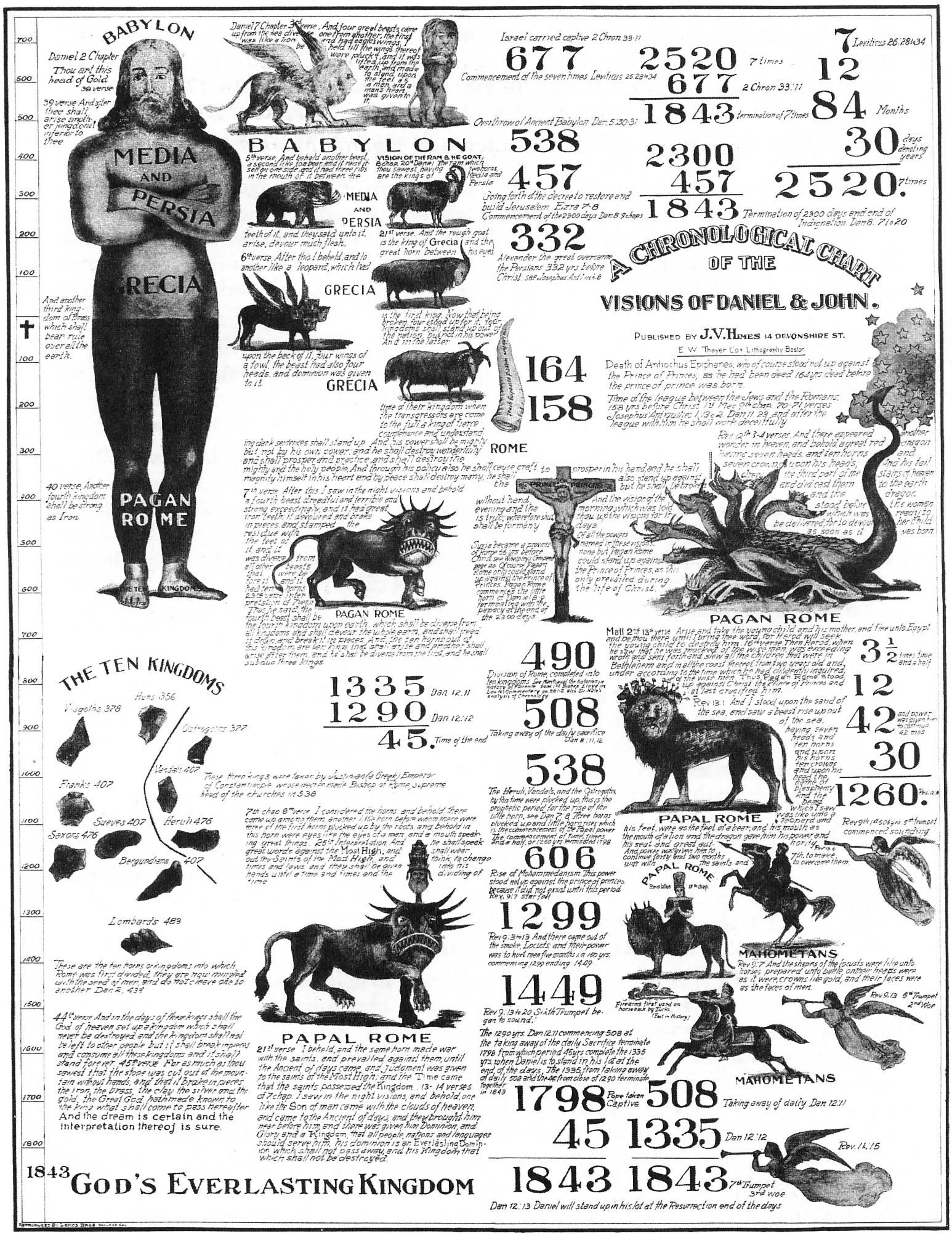
It can be demonstrated that much of what Herbert Armstrong taught regarding prophecy came from William Miller. Just take a look at this prophetic chart from William Miller in 1843 and see if you recognize this from Armstrong's works and even modern publications in the COGs. It should appear quite familiar to you. So here we have Herbert Armstrong whose prophetic claims failed in no small part because he perpetuated the earlier failures of William Miller. Armstrong extracted the man William Miller yet kept his failed teachings. And the COGs are falling into exactly the same pit right now!

But William Miller isn't the only source from whom Armstrong borrowed.

G. G. Rupert was born a Methodist but later joined the Seventh Day Adventist movement. He went on to found the Independent Church of God. He believed Christians were required to keep the laws of the Old Testament, including Holy Days and dietary laws; taught church eras; and taught that Sabbath-keeping groups were the only true Christian churches. In 1917, Rupert started a periodical he called the "Remnant of Israel" which espoused a form of British Israelism, claiming the United States was descended from the tribe of Ephraim.

Many sources claim that Ambassador College employees found boxes of the "Remnant of Israel" publication in HWA's basement. If this is true, it would seem to support claims that Armstrong borrowed heavily from Rupert's writings. Similarities between HWA's writings and Rupert's writings, including topics, conclusions, and general writing style, lends considerable weight on its own. As we can see, Herbert Armstrong was demonstrably not the only one teaching what he did.

Some have set out to demonstrate that Armstrong plagiarized portions of many others' publications and passed them off as his own research. (See our article "This Has All Happened Before" for more details.) The most notable case is HWA's United States and the British Commonwealth in Prophecy, which was published in 1954, and appears to have largely plagiarized Judah's Sceptre and Joseph's Birthright, written by John Allen Harden in 1902. Joseph Tkach, Jr., a leader of the post-1995 Worldwide Church of God, had this to say about the booklet:
"In fact, it is no secret that Herbert Armstrong's "The United States and British Commonwealth in Prophecy" was copied from a book titled Judah's Scepter and Joseph's Birthright by J. H. Allen. It is possible to run down almost the entire list of "new truths" supposedly revealed to Mr. Armstrong and point out where he got them and what preceded them." (Joseph Tkach, Jr., Transformed by Truth, Chapter 7).
WCG withdrew the United States and British Commonwealth in Prophecy from circulation in 1990. Say what you want about the Tkaches, but you must recognize that they took a stand for what they believed, even though they knew withdrawing the booklet would be wildly unpopular among the WCG membership. They realized that one cannot simply remove the man yet retain the failed material. You can compare excerpts from both books here.

(For more on how many of the doctrines "revealed" to HWA were borrowed from the COG7, we recommend you read our articles "50 Truths part 1" and "50 Truths part 2".)

So is it a crime to write about the ideas and theories of others? Of course not. I'm clearly using research from other people in this post. Although I am citing it and giving others credit for their work. The problem comes when one passes off someone else's ideas and writings as his or her own. It's even more problematic when they claim the ideas came from God.

Herbert Armstrong never cited Rupert, Allen, Dugger, Dodd, White, Smith, the Watchtower Society or any of the other writers from whom he "borrowed" in his own writings. Remember, in his November 29, 1954 co-worker letter, he certified that his teachings came not from from man, but was revealed by Jesus Christ.
"No, I know of no one else who was thrust into the Ministry of Jesus Christ, untaught by man by the living Christ through His written word, in the manner in which I was." -Herbert W. Armstrong, Autobiography, p. 318-319.
When he said that he was "untaught by man" what he really meant was he was never formally trained as a preacher. He admitted that God spoke to him through the writings of other men.
Herbert Armstrong was not by any means the only one teaching what he did. Not by a long shot. If you really want to see something, we recommend you read the book Churches That Abuse by Ron Enroth. There are a great many groups out there with absolutely no connection to the COGs who teach strikingly similar things and make eerily similar claims to that of Herbert Armstrong, and this book documents several.

There is nothing inherently wrong with HWA learning doctrinal truth from other people. It's the model God created for His church. But there is a problem with him passing off the teachings of others as his own, claiming they came directly from God. Which leads to my next point.

4. Herbert Armstrong wasn't perfect. No one is. By your rationale, you would have rejected David - a man after God's own heart - as king of Israel because of his sins with Bathsheba.

And by this same rationale, would this same defense apply to Nimrod, or the Pope, or Ellen G White?

I don't think that Herbert W. Armstrong had to be perfect to start a church. There's only been one perfect man, and HWA wasn't Him. HWA wasn't perfect, and neither am I, neither is my pastor, neither is my Bible study leader... the list goes on. And includes everyone. All of us have sinned and fallen short of God's perfection. So I'm not going to ramble on about the Czar's golden flatware or Steuben crystal or $2,500 bottles of Remy Martin Lousi XIII cognac in the special baccarat decanter. I won't focus on the makeup flip-flop, the Pentecost controversy, or on the families destroyed by WCG's policy on divorce and remarriage in the years before HWA's own divorce.

I originally planned not to mention the most troubling accusation against HWA. But then I noticed that, in one of the Living Church of God articles I quote later, Rod Meredith states that those who accuse HWA of "major sins" often have no proof whatsoever. (Note that he said "often" and not "never.") I simply cannot let that statement go unchallenged. So I'll just include this link for those who are inclined to read about it. It's important to note that HWA never filed a libel suit against David Robinson for the claims he made in his book; he simply tried to prevent the book from being published, as the link's author also points out. The allegations were reported as fact during HWA's divorce proceedings with Ramona Martin. Even UCG's own Gary Antion is reported to have said he knew the claims were true since the 1970s. And with that, I will move on.

Matthew 7:15-17 tells us we will know a false prophet by his fruit. What was HWA's fruit like? What was he known for, the fruit of the spirit - love, joy, peace, patience, kindness, goodness, faithfulness, gentleness and self control? As Christians, we are supposed to grow in the fruit of the spirit over the course of our lives. What does the fruit of his church look like? Gentleness, love, forbearance, kindness? Good, healthy trees don't grow bad fruit, Matthew 7:17 tells us. Did HWA gently tend the sheep in his care? Did he gather the lambs in his arms, as Jesus instructed the apostle Peter to do? Or was he a different kind of shepherd?

There are many examples of difficult words HWA wrote to the WCG membership. Perhaps the most troubling letter was written on March 2, 1967, addressed to the "Brethren and Co-Heirs of God." At this time, his wife, Loma, was critically ill with a bowel obstruction. Armstrong wrote that the Holy Spirit produced her tragic illness to awaken Church leadership and membership to the fact that they had become spiritually sluggish. It's a long letter, so please allow me to quote from the most relevant sections. The only changes I have made to these sections are to refrain from HWA's practice of capitalizing letters for added emphasis, only because it slows down my typing too much.
"Brethren, I have suffered as perhaps never before, with my wife lying there - with a bowel blockage that held locked inside of her putrid human waste - knowing that unless God grants her continued life by a miracle of healing, I would have to go it alone, without her. And Jesus has looked down upon His beloved wife, whom He loves, as I so deeply love my wife. And as I have seen my wife about to die unless purged of this physical poison, so Jesus sees His wife - our church - about to die for eternity, unless we are purged of our spiritual poison."
"It may be that God is still waiting for this spiritual awakening to spread through the whole church - on down to the last member - even you! before my dear wife can be delivered, and completely healed and restored to active, vigorous health."
"Many professing to be church members say, when a co-worker letter arrives, in a grumbling, complaining disgust, 'Oh, that's just another of Mr. Armstrong's requests for money,' and many don't even read the letter."
"Are you one of those? If so, let me burn your ears before the almighty God burns you in the Lake of Fire! If that has been your attitude - if you are only on the getting side, and shun helping, and giving to the cause of God, then I say to you on authority of Jesus Christ, if you don't repent and quickly, and change that hostile, despicable, detestable attitude, you do not belong in God's Church! You are some of the rotten, putrid, spiritual waste that has been plugged up inside the spiritual body of Christ's wife, just as the physical waste is plugged up in my dear wife's body! And the living Jesus is just as able to expel you from the spiritual body of his wife as He is to expel this physical waste from my wife's body."
So how has the Church been "falling down on the job," as HWA asserts? Well, the church was in the middle of a building campaign to expand Ambassador College and church mail processing facilities. Without more space for students or room to process mail, the work could not grow. Special offerings for the building fund - those over and above tithes and regular offerings - had dwindled to about half the amount from the previous year, even though membership was up by 30 percent.
"Think of it! How ashamed God must be with this, His Church!"
I have no words to follow up on the content of this letter, other than to urge you to heed the words of Hebrews 13:7. Remember what those who rule over you have taught you, whose faith you follow. Consider the outcome of their conversations and conduct. You can read the full text of the letter here if you wish.

So why am I writing all this? I must really despise Herbert W. Armstrong and harbor bitterness toward everyone the COG ministry. Not really. I was indifferent about the man for years. It's hard to work up a deep loathing in a matter of months. Even now, as I read his letter calling people I've known and loved "rotten, putrid spiritual waste," all I can really do is shake my head. And the ministers? Some of these guys were a big part of my childhood and teenage years. It sometimes pains me to quote men who, years ago, taught this shy young girl to play YOU basketball or shoot a rifle at youth camp.

Maybe it's because I think everyone in the COGs is a dummy? No, that's not it either. Remember, I was there for years. It took me almost two years to untangle the convoluted doctrinal web to the point I felt marginally comfortable leaving. In some cases, I'm still working on it. And I still have family there. A few of you folks even still consider me to be a friend.

I know. I must be really bored, so I sit around picking on HWA and the COGs all day. I need to get a life. I probably should just turn off my computer and watch "Dancing with the Stars" like everyone else. I've "thrown the baby out with the bathwater" and now I obviously don't have anything else going on. No, I assure you, that's not it either.

So why do I do it? Believe it or not, it's because I care about you. First of all, God loves you and calls after you. That is my primary motivation. Second, Galatians 4 and 5 have some strong words for those who believe observance of Sinai Covenant laws factor into their salvation. I'm concerned for your eternal spiritual welfare. 

I could just hang it up and use my computer to play Candy Crush Saga while the COGs come to nothing, like Gamaliel described in Acts 5:38. Surely, deep down, you know that's where the COGs are headed. But that doesn't mean I want you to suffer through the fallout. I've been through splits, and I've cried through the isolation. It's not going to get any better as time marches on, and deep-down you know. You hope it won't, but you know it will. My heart aches when I think of the future the youngest in my family have ahead of them. Herbert W Armstrong is primarily responsible for the doctrines and the interpretations and the points of view and the attitudes that have caused splinter after splinter. If holding to those is what God expects of you, what He requires for salvation, then it's worth it. Anything is. But what if it isn't? What if the teachings of HWA handed down through his disciples are not what God requires of you at all? What if the problems you see all around you, the splits, the egos at the top, the failed prophecies, the difficult scriptures, the anomalies with history and science, and all the rest, aren't because of a cosmic conspiracy against you but rather because the system itself is fundamentally flawed and it's just behaving as all fundamentally flawed systems do? Jesus came for you to have an abundant life, not the one that lies ahead of you in the COGs. 

Finally, I want you to experience the full blessings of the New Covenant. The blessing of salvation by grace, through faith in the shed blood of Jesus. The blessing of peace that surpasses all understanding. The blessing of truly understanding grace, and the restoration it allows in your relationships with others. None of these are possible while you are actively steeped in HWA's doctrines and his misconceptions about the historic Christian faith. In my next post, I will explore one of the biggest myths in the COG young adult mind - the belief that Herbert W Armstrong and his mistakes don't influence their churches today.

You can find part 1 of this series here. You can find part 3 of this series here.

************
It is important that you understand; Everything on this blog is based on the current understanding of each author. Never take anyone's word for it, always prove it for yourself, it is your responsibility. You cannot ride someone else's coattail into the Kingdom. ; ) Acts 17:11
************

Tuesday, November 4, 2014

Herbert W Armstrong: Why He Still Matters

"I want to tell you that all this weather disturbance means a terrible famine is coming on the United States that is going to ruin us as a nation inside of less than 20 more years. All right, I stuck my neck out, right there. You just wait 20 years and see whether I told you the truth. God says, 'if a man tells you what's going to happen, wait and see. If it doesn't happen, he was not speaking the word of God, he was speaking out of his own mind.' You watch and see whether these things happen. You see who's speaking to you, my friends."
-Herbert W Armstrong, World Tomorrow broadcast, mid-1950s.
If you recently attended the Feast of Tabernacles with a Church of God splinter group, you probably heard at least one reference to Worldwide Church of God founder Herbert W Armstrong during the festival. Some of you at the more senior end of the spectrum may have gotten a little misty-eyed. Others of you - mostly in the under 40 crowd - probably tried hard not to roll your eyes.

I can totally relate. I was in your place, barely suppressing that eye roll as recently as five years ago. Herbert Armstrong died when I was young. I had no emotional attachment to him. He was little more than a footnote in my COG experience. The splinters I attended distanced themselves from him. So on the rare occasion that a speaker waxed nostalgic about him, the voice in my head was yelling "Move on! He died more than 25 years ago!" I thought he was irrelevant.

I was wrong. Totally wrong. Herbert Armstrong is extremely relevant. Few things could be more relevant.

Let me state up front that this post isn't a rant about how much I dislike HWA. For most of my life, I regarded him with apathy, when I regarded him at all. It was only when I started searching for answers about the state of the WCG splinter groups that I understood just how relevant he was to everything I had been taught.

Many COG groups distance themselves from HWA, especially his claims to be an apostle who received revelation directly from Jesus Christ. So it strikes me as intellectually dishonest for them to uphold his teachings as divinely inspired. In this post and others, I'll address arguments along these lines that I myself made as a COG member or have heard others make.

1. Scriptures condemning false prophets don't apply to Herbert Armstrong. He never claimed to be a prophet.

So, he's not a prophet? Then what is he, a fortune-teller? Is that really any better?

It's true that HWA technically called himself an apostle, and never used the phrase "I am a prophet." But! He was indeed seen as a prophet, regardless of what some today might lead us to believe. Gerald Waterhouse, the most vocal evangelist in the WCG, went on speaking tours throughout the church and often waxed on for hours at a time extolling Armstrong's prophetic greatness. Waterhouse would often make ludicrous claims such as, "If Christ doesn't return in Mr. Armstrong's lifetime, the Bible is false!" Bold words! But not so bold after all, since this is essentially the same claim that the UCG makes when they attempt to demonstrate how wrong the Apostles were on the timing of the return of Jesus. They defend Armstrong's foibles by pointing out that the Bible is wrong. Wise? Probably not. We ask, were the Apostles wrong, or is there just something fundamentally incorrect on the UCG's understanding of what the Apostles were saying? Best bet is the latter. Where did the UCG get their understanding of what the Apostles were saying in the first place? From the very man they admit was totally wrong. Whereas Waterhouse said, "If Armstrong was wrong then the Bible was wrong," the UCG says, "Armstrong was wrong, but the Bible is wrong too." We find it the apex of irresponsibility to stand on this defense. Is this truly the hill they are willing to die on?

And then there were statements in church publications like this:
"WHERE ARE God’s true prophets today! In this age of world chaos and sudden death, you had better rid your mind of preconceived ideas and prejudice and honestly seek to find out! Listen! This work has been warning America of definite and tremendous events to come for many years! ... They use the words “may," “could,” or “might.” They are afraid to be definite and specific! The truth of the matter is that they DARE NOT be specific about the future because they just DO NOT KNOW what the Bible says is going to happen! But on “The World Tomorrow” broadcast and in this magazine we have dared to unlock the Bible prophecies and apply them to specific nations and events that are NOW being affected. Do you grasp the SIGNIFICANCE of this?"
-Plain Truth Aug. 1957, p.3 (bold mine)
Oh, we grasp the significance alright. The church did see itself as having "true prophets" who made prophetic statements under divine influence. (For more, see our article, "An Inconvenient Plain Truth".) But it wasn't just future prophecies, no. Armstrong also claimed to have divinely-revealed understanding of the interpretation of ancient Biblical prophecies. He spoke as if the Bible itself was written for him personally, and you could tag along.
"And, knowing that such an unbelievable catastrophe is soon to strike, I HAVE TO WARN YOU!! You can read what God says to me in Ezekiel 33: 1-6."
-Herbert Armstrong, 1975 In Prophecy, p. 20 (bold mine)
What God said to him through Ezekiel?? So, God supposedly wrote the Bible to Herbert Armstrong, but he's not really relevant to anything? We respectfully disagree.
Armstrong understood himself as the end-time fulfillment of several Biblical types.
"Although God has personally given Mr. Herbert W. Armstrong no commission, he nevertheless feels that virtually every commission God has ever given is his. Mr. Herbert W Armstrong either thinks he is, or is to do the job given to: Isaiah, Jeremiah, Ezekiel, the 'watchman,' the 'inkhorn,' the one who 'cries aloud and spares not,' Elijah to come, a type of John the Baptist, either Joshua or Zerubbabel, one of the two witnesses, an apostle, a 'messenger' one who 'prepares the way,' Hosea, Malachi, Moses (anyone who disdains Mr. Herbert W. Armstrong’s authority or position is immediately compared to Korah), Daniel, Joel, Amos, etc., etc., etc. And, of course, he primarily feels he is to fulfill Matt. 24:14 -- see Rev. 14:6 for the most likely individual to take care of that job."
-Taken from Robert Garringer's 1975 letter to Charles Hunting, as posted on the Exit and Support Network website.
Most popular of all was how Armstrong called himself the end-time Elijah. Click here for a YouTube video entitled "The End Time Elijah - Herbert W Armstrong" for one example. Or, here again:
"It is revealed in Malachi 3:l-5 and 4:5-6 that God would raise up one in the power and spirit of Elijah, shortly prior to the Second Coming of Christ. In Matthew 17:11 Jesus said, even after John the Baptist had completed his mission, that this prophesied Elijah “truly shall first come, and restore all thigs.” Although it is plainly revealed that John the Baptist had come in the power and spirit of Elijah, he did not restore anything. The human leader to be raised up somewhat shortly prior to Christ’s Second Coming was to prepare the way-prepare the Church-for Christ’s coming, and restore the truth that had been lost through the preceding eras of the Church."
-Herbert W Armstrong, Mystery of the Ages, 1985 edition, pp. 290-291
This doesn't just apply to Armstrong as some nickname, it claims he had the power and spirit of Elijah. The last time I checked, Elijah was a prophet, and one of the greatest of them. When Elisha received the spirit and power of Elijah, he also became a prophet. When John the Baptist came in the power and spirit of Elijah, he too was a prophet. And this is precisely what everyone in the WCG understood Armstrong's claims to mean! When the imprisoned "Spokesman of the Two Witnesses," Ron Weinland, set out to eclipse his former master, Weinland opted to claim to be an even greater Elijah than Armstrong was. (For a great deal more on this, see our articles "Elijah - Ron Weinland or Herbert W, Which?", "Herbert W Armstrong: End-Time Elijah?", and "The Plain Truth About the End-Time Elijah".)

Only Elijah and John the Baptist never went around wildly speculating on time-specific events. (Nor either did the Apostles, but we digress.) Everything happened precisely as they said it would. But we are supposed to overlook all of this.

Several sections in the Bible were written to HWA, he is the fulfillment of multiple Biblical types, he is the end-time Elijah, he was the first person in 1,900 years to preach the Gospel, he is the "founder and spiritual and temporal leader of the Church of God on earth," God spoke to him and through him ...but Armstrong never uttered the magic phrase, "I am a prophet", you see, so he's irrelevant and it's all just harmless exuberance.

Armstrong doesn't help his case by concluding statements with phrases like, "thus saith the Lord," as in this prophecy about Mussolini triggering the battle of Armageddon:
"But then what will Mussolini and these ten dictators do? Notice the prophecy - absolutely sure to happen - in Revelation 17:16-17... Thus shall the Catholic Church come to her final end. Thus saith the Lord."
-Herbert W. Armstrong, The Plain Truth, March 1938, p. 8.
While we're on the topic of HWA's failed World War II prophecies, let's consider the time that he said the war that would usher in the Great Tribulation could start within two months' time... in 1939.
"Once world war is resumed, it must continue on through the great Tribulation, the heavenly signs, the plagues of the Day of the Lord and to the Second Coming of Christ, at the last battle, at Armageddon! This you may know! This war will be ended by Christ's Return! And war may be started within six weeks! We are just that near Christ's coming! That should make every reader stop to think."
-Herbert W. Armstrong, The Plain Truth, August 1939, p. 6.
You know what made me stop and think? When I read that HWA said that the Bible showed that Hitler would be victorious in his ill-fated Russian invasion.
"Hitler is the 'Beast' of Revelation.... There, Bible prophecy does indicate that Hitler must be the victor in his present Russian invasion."
-Herbert W. Armstrong, The Plain Truth, October 1941, p. 7.
Unfortunately, HWA did not learn from his embarrassing record of WWII prophecies. Pay attention to the dates on these quotes.
"It's time we face the hard, cold, realistic fact: humanity has two alternatives: either there is an Almighty, all-powerful God who is about to step in and set up the kingdom of God to rule all nations... or else there will not be a human being alive on this earth twenty years from now!... It's about time you come to know who are the false prophets, and who is speaking the true Word of God faithfully."
-Herbert W Armstrong, 1962, Just What Do You Mean... Kingdom of God, p. 19.
"The 'Day of the Eternal' - a time foretold in more than thirty prophecies - is going to strike between five and ten years from now! You will know, then, how real it is... I am not writing foolishly, but very soberly on authority of the living Christ."
-Herbert W Armstrong, The Plain Truth, February 1967, p. 47.
All in all, HWA had hundreds of failed prophecies. You can call them predictions, if it makes you feel better, but there are still more than 200 of them. Deuteronomy 18:20-22 is very clear on the matter of false prophets.

"But the prophet who presumes to speak a word in My name, which I have not commanded him to speak, or who speaks in the name of other gods, that prophet shall die. And if you say in your heart, 'How shall we know the word which the Lord has not spoken' - when a prophet speaks in the name of the Lord, if the thing does not happen or come to pass, that is the thing which the Lord has not spoken, the prophet has spoken presumptuously; you shall not be afraid of him."

This passage does not give wiggle room. It does not allow us to say, HWA was right, his timing was just a little off. It seems to give a cutoff date, not allowing years to pass to see if maybe the prophecy will come true later. Just saying "bad things have happened and are happening more frequently" doesn't count. The Bible says that. But the Bible doesn't set dates. HWA did. So, did HWA speak presumptuously in the name of the Lord? "Thus saith the Lord." "I am not writing foolishly, but very soberly on the authority of the living Christ." You tell me.

If I made the rules, I probably wouldn't be as harsh as Deuteronomy 18 prescribes. No one's perfect. Everyone has an off day now and then. But it's not up to me. When you claim to speak for God, you have to get it right. HWA did claim to speak "the TRUE MESSAGE FROM GOD" (1975 In Prophecy p. 28), and HWA did claim that he spoke "on the authority of God Almighty" (1975 In Prophecy p. 31), but HWA didn't get it right.
Unlike Deuteronomy, I'm not asking for anyone's blood. I'm just asking you to take an honest and unbiased look at the facts.

2. Herbert W Armstrong was a fallible man, but he still revealed a lot of truth despite his problems.

This is a nice thought, but it contradicts the very authority by which HWA established this "truth." It contradicts what the founder of the religious movement taught and believed about himself. Herbert W Armstrong claimed to be God's apostle. He stated that God dealt with him "in no uncertain terms, even as he had dealt with Moses, Isaiah, Jeremiah, Jonah, Andrew, Peter and the apostle Paul." (Herbert W Armstrong, Mystery of the Ages, p. 14).
"I wonder if you realize that every truth of God, accepted as truth doctrine and belief in the Worldwide Church of God, came from Christ through me, or was finally approved and made official through me... I was appointed by Jesus Christ, the head of the Church."
-Herbert W Armstrong, "Personal From..." The Plain Truth, Feb. 1977, p. 17.
It's one thing for a Christian layperson or pastor to make doctrinal errors. It's quite another thing for an apostle to do so. As an apostle, you are either divinely inspired or you aren't. Did Peter sin or make errors in judgment? Sure. But did Peter and Paul make doctrinal errors? In multiple publications, HWA claimed God worked with him similarly to the way He called the apostle Paul. In this Co-Worker letter from November 29, 1954, Armstrong references Galatians 1:11-12.
"And so I say to you, as the Apostle Paul said to those at Galatia. I certify you, brethren, that the gospel which is preached of me is not after man, for I neither received it of man, neither was I taught it but by the revelation of Jesus Christ... When it pleased God, who... called me by His grace, to reveal His Son in me that I might preach Him to the world; immediately I conferred not with flesh and blood - neither went I to any sect or denomination or human theologian, but I went directly to the word of God, on my knees, corrected, reproved , and instructed in God's righteousness and truth."
Incidentally, how exactly did HWA claim he knew God called him to apostleship? Through a vision-like dream his wife Loma had just days after their wedding. In her dream, she and HWA were crossing the stream when they noticed a banner-shaped mass of stars in the sky. The stars quivered and separated twice, then three white birds flew toward them, turning into angels as they approached. In the dream, Jesus Christ descended from among the angels. He put His arms around HWA and his wife, then turned back into an angel. Loma asked the angel if it was wrong for her and HWA to go to the movies so much. The angel replied that Christ had important work for them to do and there would be no time for movies. Then the angel vanished. (Mystery of the Ages, p. 15-17). HWA tried to put the vision out of his mind, but God soon got his attention through the loss of his business. His business fell apart in the flash depression of 1920, when major clients like Goodyear and John Deere fell through.

I'm not saying Loma and HWA made all this up. I'm not saying that there was no dream, or that they didn't find it convincing. There's no doubt that dreams can be inspired by God. After all, Peter saw a vision of unclean animals on a blanket. John had visions of locusts, horses and dragons. Those dreams sound strange, too. Although theirs have a bit more street cred since their dreams came after their apostleship had been established, instead of being the means through which they declared their apostleship. So I guess what I am saying is that if I ever declare my apostleship, I hope I will base my claims on something a little more substantial. Temporary blindness, complete change in life direction along the lines of Paul's experience. Not my business falling apart in a stock market crash. That happened to a lot of people. If God used this to reach HWA, just imagine what He must have been trying to tell Goodyear and John Deere!

Not only did HWA claim Jesus predicted his work in Matthew 24:14 and Mark 13:10 (per HWA's personal letter to cult and false religion writer Robert Sumner, dated November 27, 1958); he also claimed God suppressed the "true gospel" for almost 2000 years in the lead-up to his end-time work. The gospel was hidden from the world from the time of Christ's apostles until a century of 19-year-time cycles (Herbert W Armstrong, Mystery of the Ages, p. 294). The time cycle thing also somehow figured into everything from the expiration date of God's curse against the Israelites, to the Louisiana Purchase, and to the beginning of the "Philadelphia Era of the Church of God" under HWA's leadership. Don't ask me to explain 19-year time cycles, I never understood them. I do, however, understand that this claim seems to contradict Matthew 16:18, which indicates the gospel would never disappear. It also seems to contradict modern COG attempts to trace themselves back to the Mumfords, the Seventh Day Baptists, the Waldensians and any one else who would lend them an air of credibility. More on that later.

Is it possible that God truly did inspire Herbert W Armstrong in some ways, but didn't bestow upon him the role of apostle? Certainly God could have cleared up that detail at some point. But Armstrong never deviated from his claim of divine apostolic inspiration. The above quote about God dealing with him similarly to Moses, Isaiah, Jeremiah and Peter came from Mystery of the Ages, which was printed the year before his death.

So why am I writing this? Because I want to sling mud at Herbert Armstrong? Because I am bitter toward the leadership in the COG splinter groups? Absolutely not. Compared to others, I led a relatively easy life in the COGs. Growing up in WCG did have some positive fruit - it ingrained within me a belief in God, respect for the Bible, knowledge of scripture and a strong sense of morality. I have no deep-seated anger toward HWA, although some of the things I've read leave me with the heebie-jeebies.  I regarded him much like the wacky older second-cousin-in-law at the family reunion. You know who I'm talking about - the one who makes off-the-wall comments that everyone pretends they don't hear.

No, I didn't leave the COGs because of HWA. As far as I was concerned, truth is truth, no matter who says it. I left because I saw many doctrines were not true. It was only afterward, as I struggled to understand where some of the issues I saw originated, that I learned so much more about this man. Some of you attend COGs where Armstrong is mentioned almost weekly, where institutions are named after him. You know that he matters. But others of you attend splinters that have distanced themselves from HWA, where he is downplayed. I am writing because you need to be aware that what you now believe as a member of a COG group hangs on Herbert Armstrong. You need to be aware of these things. And more, which I will continue next time.

You can find part 2 of this series here. You can find part 3 of this series here.

(Oh, and in case you are wondering, the video clip I quoted in the introduction can be found here  between time markers 5:10 and 5:42).


For an example of how Armstrong IS still important to the system he started, read the post "Our Connection To Jesus Christ Only Exists Because Of Herbert Armstrong" over at the Banned blog.


************
It is important that you understand; Everything on this blog is based on the current understanding of each author. Never take anyone's word for it, always prove it for yourself, it is your responsibility. You cannot ride someone else's coattail into the Kingdom. ; ) 
Acts 17:11
************