Saturday, December 25, 2010

Psychology of the Spirit

I was watching a presentation given by a neurologist, Vilayanur Ramachandran. What he had to say regarding the mind was fascinating. I saw in what he was talking about parallels regarding spirituality and our relationship with God.

I have often wondered about the mental condition of angels who sinned by abandoning faith in God for faith in Satan, and what happened to Adam and Eve from a mental health perspective when they abandoned faith in favor of listening to Satan and their subsequent belief they could be, or were, self-sufficient. This may be describing the issue in a somewhat overly simplistic way, but the reader should get the idea.

Something happened to the minds of the angels who sinned. Something happened to the minds of Adam and Eve when they sinned. Something happened to me and others when they bought into the legalistic false gospel of sabbatarianism. Something happens to people in general who buy into false religion. All mankind suffers from a mental illness that defies diagnosis. But, because all mankind suffers from this mental illness, to one degree or another, it goes unnoticed, for if everyone suffers from the same neurological disorder, the disorder is perceived as the norm. This disorder is described in Scripture, and uses blindness as an analogy for this disorder. The sufferer of this disorder is blind to the fact they have this disorder. They do not perceive there is a disorder, therefore they conclude there is no disorder.

But something is definitely missing. Something is deficient.

Scripture diagnoses the problem in general terms, and Scripture relates the cure.

Ah sinful nation, a people laden with iniquity, a seed of evildoers, children that are corrupters: they have forsaken the LORD, they have provoked the Holy One of Israel unto anger, they are gone away backward. Why should ye be stricken any more? ye will revolt more and more: the whole head is sick, and the whole heart faint. From the sole of the foot even unto the head there is no soundness in it; but wounds, and bruises, and putrifying sores: they have not been closed, neither bound up, neither mollified with ointment. – Isaiah 1:4-6

And I will give them one heart, and I will put a new spirit within you; and I will take the stony heart out of their flesh, and will give them an heart of flesh: That they may walk in my statutes, and keep mine ordinances, and do them: and they shall be my people, and I will be their God. – Ezekiel 11:19-20

Then will I sprinkle clean water upon you, and ye shall be clean: from all your filthiness, and from all your idols, will I cleanse you. A new heart also will I give you, and a new spirit will I put within you: and I will take away the stony heart out of your flesh, and I will give you an heart of flesh. And I will put my spirit within you, and cause you to walk in my statutes, and ye shall keep my judgments, and do them. And ye shall dwell in the land that I gave to your fathers; and ye shall be my people, and I will be your God. I will also save you from all your uncleannesses: and I will call for the corn, and will increase it, and lay no famine upon you. And I will multiply the fruit of the tree, and the increase of the field, that ye shall receive no more reproach of famine among the heathen. Then shall ye remember your own evil ways, and your doings that were not good, and shall lothe yourselves in your own sight for your iniquities and for your abominations. – Ezekiel 36:25-31

And in them is fulfilled the prophecy of Esaias, which saith, By hearing ye shall hear, and shall not understand; and seeing ye shall see, and shall not perceive: For this people's heart is waxed gross, and their ears are dull of hearing, and their eyes they have closed; lest at any time they should see with their eyes, and hear with their ears, and should understand with their heart, and should be converted, and I should heal them. – Matthew 13:14-15

But though he had done so many miracles before them, yet they believed not on him: That the saying of Esaias the prophet might be fulfilled, which he spake, Lord, who hath believed our report? and to whom hath the arm of the Lord been revealed? Therefore they could not believe, because that Esaias said again, He hath blinded their eyes, and hardened their heart; that they should not see with their eyes, nor understand with their heart, and be converted, and I should heal them. – John 12:37-40

But when Jesus heard that, he said unto them, They that be whole need not a physician, but they that are sick. But go ye and learn what that meaneth, I will have mercy, and not sacrifice: for I am not come to call the righteous, but sinners to repentance. – Matthew 9:12-13

The cure is this new heart. We understand this to be God's Holy Spirit. But this is only part of the equation of the cure.

The fallen angels had the Holy Spirit, and their sin resulted in mental disorders we would recognize as severe.

We also have the example from Scripture where king Saul of Israel was given God's Spirit, and he too succumbed to severe mental disorders.

The rest of the equation for a healthy individual is faith; faith in God. The cure then is twofold; faith in God in conjunction with being in possession of God's Holy Spirit. Faith is total reliance in God.

There's a category of people who refuse the cure because they think they have already gone through the therapy. These are those who have put their faith in the “quack” physicians who impersonate Christ and His ministers. Their cure is a placebo. The basis of their cure is the old covenant law they teach to be of faith, when in fact the apostle Paul stated that the law was not of faith. Their substitute Holy Spirit is also the law, for they teach that it is that law placed within the believer, and not a Spiritual “law” that Scripture shows to be God's Holy Spirit.

The result of this bogus cure is self-righteousness, arrogance, boasting, bragging, and other symptoms of an inflated Id and Ego. From this position, there is no perception of needing to be cured; there is no need of a physician. Their “righteousness” is embedded in the law and not Christ. Christ is given lip service. They have compounded their illness with a blindness now that cannot recognize the real Christ from their contrived one that is actually the law. Christ and the law become blurred. Paul recognizes this compounded illness in II Corinthians chapter 3.

When I was undergoing the process of throwing off the teachings of the old Worldwide Church of God, there was a day where I was grasping concepts of the new covenant, but the very next day, when I went to explain some aspect of it to another member, I couldn't do it. I couldn't remember what I understood so well the day before. That is when I started writing down everything. In time, I got to the point where I looked back on the beliefs of the WCG and could hardly believe that I believed that whole web of confusion. What then really happened to my mind?

It was rewired. God intervened and fixed the mind so that it was freed up from the circularly locked rationale common with those who accepted the wrong therapy.

I and others who have escaped sabbatarian legalism are now amazed when dealing with those who are still ensconced in that legalism how tenacious their minds hold on to those beliefs and reject any and all information contrary to that belief system. Why? They have a blindness we cannot cure. Like a horse, we can “lead them to water” but we can't make them drink.

When Paul preached to Jew and Gentile, some Jews believed the message of the gospel, and many did not. What was the common denominator regarding those who rejected the gospel message and thus rejected Jesus Christ? Their reliance on the law and the righteousness they believed they derived from it.

You can't drag a sick man to the doctor if he thinks he is well. They won't even admit to the symptoms they display, for the ego refuses to recognize itself as being a “hard heart.”


************
It is important that you understand; Everything on this blog is based on the current understanding of each author. Never take anyone's word for it, always prove it for yourself, it is your responsibility. You cannot ride someone else's coattail into the Kingdom. ; )Acts 17:11
************

Saturday, December 18, 2010

United Church of God - Divided

We haven't said anything on the disintegration of the United Divided Church of God - A (formerly) International Association. Some people might wonder why? Don't we care?
Sure we do! It's because we care that we're not saying anything about it.

There are already lots of places to get information on this. Felix is reporting on it. J is reporting on it. In fact, J has an informal and confidential survey for UCG members if you're interested. No2HWA is reporting on it. And others!
I also keep an eyeball on the FaceBook groups, like "United Church of God - Resolving Issues", and especially websites like the UCG Current Crisis.

**UPDATE**
Here is an interesting Google map which shows the locations of the loyal and breakaway ministers in this UCG Crisis. It's not completely comprehensive, but it's still pretty good as a reference.

I would ask everyone to pray for all of the people involved in this mess (I know a few).

Personally, I would like the people involved to finally realize that this is how it goes. The leadership of the UCG are technically causing this crisis, but they aren't the root of the problem. If they were the root of the problem, as if changing the leadership will make these problems go away, then explain how this very same thing has happened in one form or the other in nearly every COG splinter group. All of them exist because of a split, and most of them have splits of their own. UCG started as a loose association of splinter groups. And this is not UCG's first split.
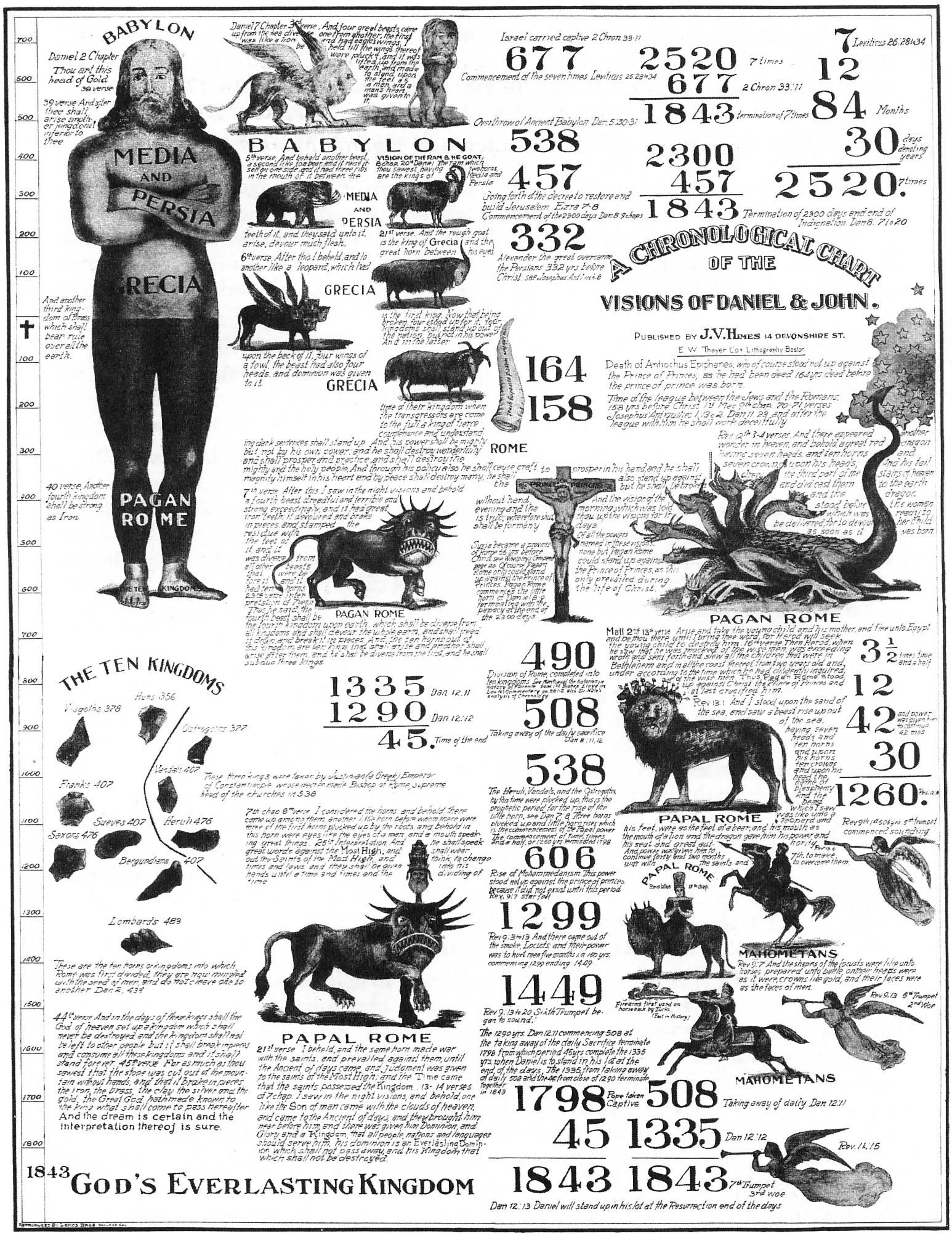
Now think of the WCG, Eternal, Global/Living, Philadelphia, CGI, Intercontinental, Fellowship, etc. etc. etc. There are literally hundreds of splinter groups out there. Don't you know that the WCG started when HWA split from the COG7? Didn't you know the COG7 started when Gilbert Cranmer split from the SDA church? Don't you know that the SDA church started when William Miller's Adventist group split up after his prophecies failed in 1843-44? Read the COG Timeline on The Journal. There is an unbroken line of breakups going back 166 years.
Now think of Rod Merideth, Gerald Flurry, Dave Pack, Ron Weinland, Wade Cox, John Ritenbaugh, Harold Smith, etc, etc, etc,. Can this be just a cataclysmic stroke of bad luck in choosing shoddy leadership? That every splinter group's leadership has done this in one way or the other? Can't be.

Something else is the cause of this - something that is shared between each of these groups. The root of the problem is in the very doctrines themselves.

Here at ABD, and we aren't the only ones, we have tried to put the very doctrines themselves to the test. We have weighed them in the balance and found them wanting.
We put what we've found here for you, for free, IF you are inclined to test and prove. I really hope you do! We don't expect everyone to just agree with us, just ask those tough questions and prayerfully consider those tough answers. But we can promise you this much -- if you just keep going on and on, doing what you've always done, well, you'll go on and on getting what you've always gotten.

Beloved children of God who are in the crumbling UCG, may God bless you and speed you into the New Covenant in the blood of our Lord Jesus Christ.

Monday, December 13, 2010

Jeremiah 10 and Christmas Trees?

There is a certain belief that is wildly popular not only in Armstrongism but in other circles as well and it goes something like this, “There is a condemnation of a Christmas tree in the Old Testament.” But is this really so?

It doesn’t matter how you feel one way or the other, we are after truth are we not? Then we need to get to the truth of the matter. If the truth is that Jeremiah 10 speaks of Christmas trees, then that is the truth, and you'd better distance yourself from that tree post haste!! But if it does not speak of Christmas trees, then you'd better distance yourself post haste from claiming that it does. Only a person who has no interest in truth would persist in propagating a known falsehood.

I used to propagate this idea heavily, especially around Christmas. To be bluntly honest, I was taught that Christmas was wrong, so I very much wanted to dislike Christmas, and so I allowed myself to be convinced by a simple argument because that’s what I wanted to believe. Whether or not the claim really was true, it agreed with what I wanted to be true, and that was good enough for me. And many others!

Well, it’s getting to be about that time of year, so I thought it might be a good idea to put this claim through the As Bereans Did patented gauntlet to see if it can survive. I’m going to put this claim to the test as I should have long, long ago but never did. Is it true or false? Is it a valid warning or a convenient excuse. Let’s test and prove this condemnation of Christmas trees, shall we?

HONESTY AND EVIDENCE

(JER. 10: 3-4) 3 For the customs of the peoples are futile; For one cuts a tree from the forest, the work of the hands of the workman, with the ax. 4 They decorate it with silver and gold; they fasten it with nails and hammers so that it will not topple.

This was so convincing to me that I went around for years of my life telling people that these two verses spoke about Christmas trees. But let's think about this critically.

If I took a person who was familiar with Christmas trees but had never read Jeremiah 10 before, handed them these verses and asked them what they think, would they look at me in astonishment and remark, "That's speaking about nothing other than Christmas trees!"? I have to tell you, I doubt that would happen (believe me, I've tried this quite a few times and I've never seen it happen).
Billions of people have lived and died, reading Jeremiah 10 several times - not just casual readings but scholarly readings as well - and have not come to this conclusion. They have to be "helped" into it.

Have you ever heard the brain teaser when you are asked to spell a few words that rhyme with "toast" and then you are asked, "What do you put in a toaster?" Most people don't think and just respond "toast." Well, that's a possibility, sure, but highly improbable. The correct answer is "bread." You put bread in a toaster. The brain-teaser is a trick. It purposefully leads you into answering "toast."

In the exact same way, people are purposefully lead into a loaded discussion on Christmas trees, and then are introduced to Jeremiah 10. It's a trick; akin to slight of hand. You are meant to see verses 3 and 4 after your mind is already conditioned to be thinking of Christmas trees. This way you are far more likely to see what they want you to see. Of course they accompany the trick with a generous amount of commentary.
So what is really going on here? It's the power of suggestion. We call this "proof-texting."

We burst into chapter 10 of Jeremiah’s book, abscond a very few verses from their proper context, set them aside as if they are an island unto themselves, conjure up a whole new meaning for them, then go about telling the whole of Christendom how God is angry with them for such and such a thing. OK. And nobody has a problem with this?

“I’m just reading God’s word straight from the Bible,” we would plead. Oh really? Just innocently reading straight from God’s word? No commentary whatsoever to nudge people towards the desired conclusion? I see.
Then what is this, “There is a condemnation of Christmas trees in the Old Testament”?
I don’t see those words in Jeremiah.

If the "plain truth" is so plain and so true, why do the verses always come packaged with the suggestive commentary? Because this is not just reading the Bible!

Are we so certain that Jeremiah is unambiguously speaking of Christmas trees, and there is no other possible explanation because it’s so very clear and so very well spelled out that all you’re doing is reading “God’s word” and not proof-texting whatsoever? So very confident, in fact, that you would go around judging others to be pagan and condemning others over it? Well, let’s just challenge that and see if it holds up.

One oft-repeated argument is to say “The word ‘Trinity’ never appears in the Bible, therefore it isn’t a Biblical concept.” But Trinitarians counter that they believe the additional Biblical evidence points to a God in three Persons. Even though Trinitarians cite multiple verses across the Bible, anti-Trinitarians reject all of it outright. I'm not arguing for or against the Trinity doctrine here. I'm speaking to standards of evidence. If this is the standard, then let’s be even-handed about it. By this standard, the phrase “Christmas tree” never appears in the Bible, ergo Jeremiah is not talking about Christmas trees. To be fair, we should dismiss any additional evidence outright (good thing there is none). Sophomoric and childish, but fair play. My point in this is - if you’re going to have a standard of proof, then have a standard of proof. A standard is a standard only if you stick to it. Otherwise you are a leaf in the wind.

I think that's the real root of this issue. It's about standards of evidence and being honest with ourselves.
The foundation of the Christmas trees in Jeremiah claim is constantly changing standards. One standard in one verse, a different standard in another. One standard here, another there. The claim absolutely relies on it. But is that godly?

Usually, standards are low when people do not want to find out what really is actually, honestly true. Some just want to find anything to uphold their predetermined view. They've compromised truth in favor of the ideology. We all do it in one way or the other. The challenge is to stop that once we learn the truth. If standards of evidence were higher, and truth the priority, then in my opinion this wouldn't happen. And blogs like this one wouldn't be necessary.

ALL TREES PAGAN?

Someone might point out that trees were used in ancient pagan worship practices, but so what? Correlation does not imply causation. That "cum hoc ergo propter hoc" fallacy has absolutely no bearing on whether or not Jeremiah 10 speaks about Christmas trees.

When I mention the very many other things people do in church that were also practiced by pagans (singing, praying, sermons, etc), usually the response is "But God lists those things in the Bible."
OK, let's go with that idea. The reasoning is - if it's something God approved in the Bible, then it's approved.

Did God approve using trees in His worship?
If Herbert Armstrong had taught the keeping of the whole law, then Armstrongists would know that God commands the use of trees in His worship.

(LEV. 23: 40) And you shall take for yourselves on the first day the fruit of beautiful trees, branches of palm trees, the boughs of leafy trees, and willows of the brook; and you shall rejoice before the LORD your God for seven days.

(NEH. 8: 13-15) 13 Now on the second day the heads of the fathers’ houses of all the people, with the priests and Levites, were gathered to Ezra the scribe, in order to understand the words of the Law. 14 And they found written in the Law, which the LORD had commanded by Moses, that the children of Israel should dwell in booths during the feast of the seventh month, 15 and that they should announce and proclaim in all their cities and in Jerusalem, saying, “Go out to the mountain, and bring olive branches, branches of oil trees, myrtle branches, palm branches, and branches of leafy trees, to make booths, as it is written.”

So, according to the reasoning, use of trees and greenery in the worship of God is OK because God approves of it in the Bible.

God specifically points out that He wants trees in His temple; evergreen trees to beautify His sanctuary:

(ISA. 60:13) The glory of Lebanon shall come to you, the cypress, the pine, and the box tree together, to beautify the place of My sanctuary; and I will make the place of My feet glorious.

God also lists the use of statues in His worship (EXO. 25: 17-19), garland, bells, and fruit (EXO. 28: 33; II COR. 3: 16), and other things I could list but won't. It is impossible, then, for these things to be pagan.

All of these things are used at Christmas, yet all are condemned by people as pagan. Is this a double-standard? Once again we're right back to talking about having a standard and sticking to it.
I guarantee you, as I live and breathe, someone reading this article right now is altering their standard. There is someone out there right now thinking, "No! No, no, no. I will not accept this." And so it goes.

Did pagans use trees in their celebrations? Yes. And so should you (if you truly believe that you must observe the Old Testament law)! So why don't you?
The Bible prescribes the use of trees at the Feast of Tabernacles, yet that is ignored. It says nothing directly about Christmas trees, yet they are condemned.

JUDGMENT AND CONDEMNATION

You want to read something that’s clear and unambiguous? Here:

(ROM. 2: 1-4) 1 Therefore you are inexcusable, O man, whoever you are who judge, for in whatever you judge another you condemn yourself; for you who judge practice the same things. 2 But we know that the judgment of God is according to truth against those who practice such things. 3 And do you think this, O man, you who judge those practicing such things, and doing the same, that you will escape the judgment of God? 4 Or do you despise the riches of His goodness, forbearance, and long suffering, not knowing that the goodness of God leads you to repentance?

To make a personal decision to not have a Christmas tree is one thing. Nothing ties salvation to Christmas trees. To judge someone based on a highly questionable reading of Jeremiah is something else entirely.

We had better be beyond certain that Jeremiah 10 is speaking of Christmas trees, my friends, because regardless of what God may think about idolatry, He is certainly not happy with judgment and condemnation – most especially that based on false accusation.
Truly one had better be exceedingly certain that Jeremiah 10 is talking only about Christmas trees. Because if it isn’t, then what is happening in reality is people are going around proof-texting Jeremiah 10, propagating falsehoods, and violating the 10 Commandments to boot…

(EXO. 20: 16) You shall not bear false witness against your neighbor.

…that is not something I would take lightly. No, not at all.

Let's stop skirting the edges and move on to the substance of the issue. Let’s ask if Jeremiah 10 condemns Christmas trees. But let’s start at the start.

CONTEXT, CONTEXT, CONTEXT

In order to avoid proof testing, we need to clamp on to the context. What do nearby verses, the entire chapter, and the neighboring chapters say? And if Jeremiah isn't speaking of Christmas trees, as I clearly suggest, then what is he speaking about?

Is it not clear from the beginning that God is making a case against Jerusalem and Judah regarding their idolatry? Go up and read the many times in Jeremiah 3 and 5 where God describes “treacherous Judah.”
So we know to whom God is speaking – Judah.

From the start, from Jeremiah 1: 16, the case is laid out against Judah for worshipping what their own hands have made. Not just decorating the home. Worshipping! Kneeling down, praying to, expecting help from. Before, during, and after chapter 10, God is clearly angry about bowing down and worshipping idol gods.
So we know what God is angry at Judah about - worshipping gods who are no gods.

And by what standard is God measuring Judah? Go down and read Jeremiah 11 and see that this is specifically about the violation of the now abrogated Old Covenant.

We've gone to prior and post chapters. The context of this portion of Jeremiah is that God is angry at Judah for violating the Old Covenant by worshipping idol gods.
That is the greater context.

Now that we have some of the context framed in, let’s focus again specifically on chapter 10 so we can see the surrounding verses.

NOT SIMPLY A TREE

Have you ever noticed how the argument usually stops at verse 4 or sometimes 5? Why is that? Because the context undoes the argument! These verses must be proof-texted because if we look closely at them the argument will fail. Let's do that now. Let's look closely at these verses.

(JER. 10: 5) They are upright, like a palm tree, and they cannot speak; they must be carried, because they cannot go by themselves. Do not be afraid of them, for they cannot do evil, nor can they do any good.”

Cannot speak??? No one believes a Christmas tree can speak. But since Jeremiah is talking about false gods carved of wood and covered in precious metals, we would expect such an idol to have a mouth. Now it makes sense.
Must be carried because they cannot go by themselves??? No one carries around their Christmas tree. (Note this is after it was fastened.) But since Jeremiah is talking about false gods carved of wood and covered in precious metals, we would expect such an idol to have feet. Now it makes sense.
Cannot do evil or good??? No one expects a Christmas tree to do either evil or good. But since Jeremiah is talking about an idol god, to which people would pray for blessings or mercy from cursing, we would expect good or evil. Now it makes sense.

(JER. 10: 6-7) 6 Inasmuch as there is none like You, O LORD (You are great, and Your name is great in might), 7 who would not fear You, O King of the nations? For this is Your rightful due. For among all the wise men of the nations, and in all their kingdoms, there is none like You.

Why this inset? Because we are contrasting the idol god, that was built and fastened, that cannot speak nor move nor dress itself, that cannot bless or curse, with the actual and Living God, who is King of nations! Try to grasp how excellent this praise is, that Jews would recognize God as the King of Gentiles. We are not contrasting God with a holiday decoration.

(JER. 10: 8-9) But they are altogether dull-hearted and foolish; a wooden idol is a worthless doctrine.

"A wooden idol." Says everything we needed right there. The Gentiles have a God but will not recognize Him, instead recognizing a useless god of wood. A Christmas tree is not a god of wood. It is not an idol. That can't be stressed enough. It's a decoration, plain and simple.

(JER. 10: 11) Thus you shall say to them: “The gods that have not made the heavens and the earth shall perish from the earth and from under these heavens."

A Christmas tree is not a false god. No person at any time believed Christmas Trees had created heaven and earth. Yet Jeremiah is talking about false gods!

I have met some who insist that Christmas trees are idols. Not so. Just look at the definition of the word. The first definition of "idol" from Merriam-Webster, paying attention to the definition that fits a religious context, is this:
" a representation or symbol of an object of worship; broadly : a false god"
http://www.merriam-webster.com/dictionary/idol

I have seen Armstrongist websites and literature replete with mentions of Herbert Armstrong or the current leadership, pictures and references to Herbert Armstrong or the current leadership everywhere, yet virtually absent any mention of Christ (I go into detail on this in the post "On Following Men" and Martha goes over it from another angle in "Herbert W Armstrong and Today's Churches of God"). So Christmas trees are idolatry, but this is not?

“But don’t people sing songs to their Christmas tree?” one might ask. The answer is no. No Christian sings songs to the tree.
Christians might sing songs about the tree. But so what? Don’t people sing songs about Zion? Or about the law? Are those things idols now, too, because you sing about them?

One might ask, "But don't people kneel before the tree. for example to get the presents?" There is a universe of difference in kneeling to reach an item and kneeling in worship. Do we not also kneel to reach items out of our kitchen cabinets? They are wood and metal, too. So do you worship your cupboards? Preposterous.

(JER. 10: 9) Silver is beaten into plates; it is brought from Tarshish, and gold from Uphaz, the work of the craftsman and of the hands of the metalsmith; blue and purple are their clothing; they are all the work of skillful men.

Metal beaten into plates??? Christmas trees are not coated with metal beaten into plates. There are various things hung on the tree for decoration, but that isn’t beaten plates of metal from Tarshish coating the tree. But an idol god is covered in precious metals. Now it makes sense.
Clothing??? Not on a Christmas tree! There are tree-skirts, but that isn’t clothing by any stretch of the imagination. But an idol statue would be clothed to cover its nakedness. Now it makes sense.

Look back at verse 3. Read it again, slowly, and pay attention to what it is saying.

(JER. 10: 3) 3 For the customs of the peoples are futile; for one cuts a tree from the forest, the work of the hands of the workman, with the axe.

Look closely at the words there, "the work of the hands of the workman." The indication of the phrase "work of the hands" is that there is a final product here; an artwork or something complex. The next several verses go on to describe this craftsmanship in greater detail. Verse 3 is not merely describing the mindless chopping of a tree. And "workman" indicates a craftsman, a carpenter or other skilled and professional artists.

This didn't escape the notice of the commentary writers. Look at Matthew Henry's commentary on this verse:
"It was a tree cut out of the forest originally. It was fitted up by the hands of the workman, squared, and sawed, and worked into shape."
Read what John Gill's Exposition has to say on this verse:
"the matter and substance of it the body and trunk of a tree cut down with an axe, and then hewed with the same, and planed with a plane, and formed into the image of a man, or of some creature; and now, to fall down and worship this must be vanity and madness to the last degree"
This is no mean tree. This is an idol god, fashioned by artists and worshiped.

Some insist that this workman in verse 3 is simply a lumberjack and nothing more, because they very much want this idol to remain a tree. These very same people insist that silver beaten into plates refers to decorations hung on a tree because they very much do not want this to remain silver beaten into plates. Here the thing must be what it is, there it must not. If in one verse the tree must be nothing but a simple tree, why in another verse can't silver plates be nothing but silver plates? Why the double standard?

Understand that the Gentiles were given over to idol gods as a punishment (DEU. 32 and the Tower of Babel episode in Genesis 11 describe this). The Gentiles didn't directly choose this. Not so with Israel. Israel is God's own peculiar people. They were not to go to idol gods. They alone were reserved for Yahweh. The Messiah, who would heal this punishment of the Gentiles and collect them back to God, would come through Israel. Yet, here Judah is, choosing the idolatry of the Gentiles of their own volition. Jeremiah is not talking about Judah using pagan traditions in their worship of YHWH. No. This is Judah worshiping other gods altogether. This is a replacement for God. The Gentiles were pushed down that path; the Jews were choosing it. God does not say, "Do not learn the way of the Gentiles," and then proceeds to describe festivities and ornamentation. No, He says, "Do not learn the way of the Gentiles," and then proceeds to describe the false gods of the Gentiles.

Context is key!
This isn't about trees. This is about Israel staying true to God so the Messiah may come. This is about the salvation of mankind.

Having specifically looked at Jeremiah 10, in the context of the book of Jeremiah, we do not see a tree decoration but a carved idol god. Let us now turn and look elsewhere in the Bible and see if we can't get some other examples that support this conclusion.
Look! Isaiah is very similar to Jeremiah. But obviously Isaiah isn't speaking about Christmas trees either.

IGNORED PARALLEL IN ISAIAH

(ISA. 40: 18-20) 18 To whom then will you liken God? Or what likeness will you compare to Him? 19 The workman molds an image, the goldsmith overspreads it with gold, and the silversmith casts silver chains. 20 Whoever is too impoverished for such a contribution chooses a tree that will not rot; he seeks for himself a skillful workman to prepare a carved image that will not totter.

It's speaking about idols; carved images, false gods. Not decorations. Not Christmas trees. But does anyone quote Isaiah? No. Because Isaiah is much more difficult to twist.
Look again!

(ISA. 41: 7) 7 So the craftsman encouraged the goldsmith; he who smooths with the hammer inspired him who strikes the anvil, saying, “It is ready for the soldering”; then he fastened it with pegs, that it might not totter.
24 Indeed you are nothing, and your work is nothing; he who chooses you is an abomination.

The idol god cannot tell the future. It cannot speak. It cannot be compared to God. This is the exact same thing God is trying to get across in Jeremiah. It is not that Isaiah is talking about idol gods and Jeremiah decorations. Both are talking about idols. Neither are talking about Christmas trees. God is upset about the vain worship of bits of wood and gold. God is not concerned with decorating the home.
Look yet again!

(ISA. 44: 9-17) 9 Those who make an image, all of them are useless, and their precious things shall not profit; they are their own witnesses; they neither see nor know, that they may be ashamed. 10 Who would form a god or mold an image that profits him nothing? 11 Surely all his companions would be ashamed; and the workmen, they are mere men. Let them all be gathered together, let them stand up; yet they shall fear, they shall be ashamed together.
12 The blacksmith with the tongs works one in the coals, fashions it with hammers, and works it with the strength of his arms. Even so, he is hungry, and his strength fails; he drinks no water and is faint. 13 The craftsman stretches out his rule, he marks one out with chalk; he fashions it with a plane, he marks it out with the compass, and makes it like the figure of a man, according to the beauty of a man, that it may remain in the house. 
14 He cuts down cedars for himself, and takes the cypress and the oak; he secures it for himself among the trees of the forest. He plants a pine, and the rain nourishes it. 15 Then it shall be for a man to burn, for he will take some of it and warm himself; yes, he kindles it and bakes bread; indeed he makes a god and worships it; he makes it a carved image, and falls down to it. 
16 He burns half of it in the fire; with this half he eats meat; he roasts a roast, and is satisfied. He even warms himself and says, “Ah! I am warm, I have seen the fire.” 17 And the rest of it he makes into a god, his carved image. He falls down before it and worships it, prays to it and says, “Deliver me, for you are my god!” 

A Christmas tree is not a god; it is not an image; it is not an idol. Isaiah, as Jeremiah, describes an idol made of familiar material by normal men. With some he makes a god and the rest he burns for heat. Nothing special in this god. But no Christian bows down to and worships a Christmas tree. No Christian prays to the tree and hopes for a response. When we put away the proof-texting and allow the Bible to interpret the Bible, this whole bit about Christmas trees crumbles to dust.

Note the striking similarities between Isaiah and Jeremiah. They both even use some of the same phrases. Yet no one cites Isaiah about Christmas trees, because it is far harder to twist. Far harder to use the power of suggestion and lead people into a discussion about Christmas trees here.

CONCLUSION

I have given you an explanation of Jeremiah 10 that is in context, has clear support from other parts of the Bible, is subject to one evenly-applied standard, and is supportable from history.

What do the "Jeremiah 10 speaks of Christmas trees" proponents give you? After building up to the desired conclusion with ample commentary, they give you an explanation proof-texted completely out of context with absolutely zero additional Biblical support; one that relies on holding one verse to one standard and another verse to another standard entirely. Not only that, but there is no support from history for their explanation either. No one has ever demonstrated that Christmas trees existed in ancient Israel nor the surrounding regions. If they weren't there, then Jeremiah simply could not be reprimanding Judah about them.
(For more on the origin of the Christmas Tree, please read our series on the history of Christmas Trees: "Falsely Accused?".)

Of course you see how silly it was to answer "toast" after you realize you've been tricked. I hope this post has helped you to understand how the trick is done.

This is not some distanced, objective, unbiased pursuit of truth we're getting from people who say Jeremiah condemns Christmas trees. I would hope that people who claim to be so very in favor of God and truth would put an exceedingly high value and priority on truth, and pursue it regardless of where it takes them. Yet, these claims of Christmas trees in Jeremiah are not truth. They're barely even opinion. And they're just wrong.

So in the end, what do we have? Another lesson on how proof-texting works.
They take only a few verses that appear to say what they want, they take them completely out of context, then they conjure up a new and improper context, and they accompany it with commentary in order to 'help' us reach the new and desired conclusion. Voila! Christmas trees!
The trick depends on us not doing our job of following through and proving it out. It depends on us having low standards of evidence.

How do we combat proof-texting? We PROVE! Read the surrounding chapters and verses. Look for parallel accounts to help explain the topic. And once we've proved, we abandon the lie and expose it for what it is.

"Now you know the rest of the story."


************
It is important that you understand; Everything on this blog is based on the current understanding of each author. Never take anyone's word for it, always prove it for yourself, it is your responsibility. You cannot ride someone else's coattail into the Kingdom. ; ) Acts 17:11
************

Monday, December 6, 2010

The God’s Law Controversy

The controversy began immediately in the 1st century and has continued. What is the eternal God's law? Is it that which came down from Sinai through Moses or is it something else that came through Jesus apart from the former law. This divide has been a central issue facing the believers in Jesus, and remains so. It goes back and forth with passion and often recrimination. One side argues: “the law of God is found in the New Testament” the other says “The law of God is that which is found in the book of Exodus and it is incumbent upon us all to submit to this law to be right with God.” This is the argument that is made in the Koran. The Muslims believe that they are keeping the law once delivered by Moses in it's uncorrupted wholeness. This divide is the central issue that is currently drawing the planet ever nearer to the brink of self inhalation because Islam has commanded that all other belief systems be eradicated and all unbelievers in the authority of Mohammad be placed under the dominion of Islamic masters by any means.

Not long ago an ABD comment pointed out that "the law of God will be written on the hearts of believers, so the law of of the Old Covenant was still in affect," end of story. No further investigation would be tolerated. No questioning if the law that was to be written on the heart was a law that God himself would keep. Since God alone is eternal both forwards and backwards, an eternal law would need to be pertinent both forwards and backwards or it would hardly be eternal.

The Decalogue (Ten commandments) is oriented to the human spiritual condition, to a nature that is drawn to evil. How could such a law have existed when God, who is love, was all their was? God's way is love, so then must be his law, and isn't it logical to conclude that this is the higher law? Ideally, this is the law I'd want written on my heart. What wonderful thing can I imagine that God cannot do? Can I imagine an ideal that could top what God has imagined? Not at all. I can imagine a better law written in one's heart than one of 'thou shall nots'. How can anyone believe God would settle for "thou shalt not" being written on one's heart instead of "I want to love"? When God writes on the heart, he is writing the code for the operating system of the mind, and there will be no need for a "thou shall not." I have frequently commented that there is no law against jumping out of an airplane without a parachute as only an insane person would have such an impulse. There is no need for a law against something that is contrary to the nature of human beings, and normally self preservation is very pronounced in that nature, that is, in the operating system of the mind.

Jesus said that 'love toward God and Love toward man' is the basic principles upon which the Law and the prophets were based. This too is said to prove the contention that the law of the Old Covenant is the Eternal law of God; but no real change was produced in the keepers of the law except in a few through God's spirit. it wasn't a result of the law itself.

The heart is in need of a re-creation. The first 10 books of the bible demonstrates that this external law is no final solution for a deficiency that can not be filled from the resources of a human being. I frequently divide law into internal and external varieties. An internal law is one that we follow because it is part of our being as apposed to an external law that has rules that contradict our internal law. We find ourselves struggling with those arias where our hearts have the greatest conflict with the external laws requirements.

The OC law does point to this more fundamental law which is love. The question is how? "The ten Commandments teaches us how to love" goes the rationalization. This statement sounds logical but it is twisting reality to conform to the preconception of the the Decalogue's eternal significance. In other word it is just a rationalization. In reality there is no example of anyone learning to love through a list of things that must be performed. The bible simply doesn't state that this is the case. In fact, the Old Testament’s lessons distilled down to their most potent concentration screams the fact that an external prescription of do's and don’ts does nothing to change the heart. This is the lesson of the entire history of Israel. What the law does is provide a line in the sand, that is, a point of reference so that sin can be identified and the resulting penalties demonstrate a little of what is truly deserved by the sinner; and the penalty was taken for all sinners by Jesus on the cross. This is the love that the law points to. Without the law there would be no means of comprehending the over arching love of our creator.

The results God desires is encoded in law, yet as already pointed out, this goal was not achieved and clearly not achievable via the enforcement of the OC (Old Covenant) law. Mat 22:37 Jesus replied: " 'Love the Lord your God with all your heart and with all your soul and with all your mind.' V38 This is the first and greatest commandment. V39 And the second is like it: 'Love your neighbor as yourself.' V40 All the Law and the Prophets hang on these two commandments." The goal God set for these qualities to become a part of human character was not achievable until they could be written in the very nature of man. You might say, in the operating system of man. How can God accomplish this? Through the New Covenant? By adding something unavailable to the people of the old: Col 1:27 “To whom God would make known what is the riches of the glory of this mystery among the Gentiles; which is Christ in you, the hope of glory.” Christ, like the prize vine of a wine maker is the rootstock of the entire vineyard. Gal 4:19 “My dear children, for whom I am again in the pains of childbirth until Christ is formed in you,

When the very nature of the human being is changed there is no longer a need for a law to curb tendencies that don't exist. The law was made to control the evil nature of man; 1Ti 1:9 “Knowing this, that the law is not made for a righteous man, but for the lawless and disobedient, for the ungodly and for sinners, for unholy and profane, for murderers of fathers and murderers of mothers, for manslayers,”

God knew from the beginning that Israel would fail and yet proceeded with the demand of obedience upon them until they fulfilled the course he had predicted,that being their failure. Deuteronomy 31:16-17 (NIV) 16 "And the LORD said to Moses: “You are going to rest with your ancestors, and these people will soon prostitute themselves to the foreign gods of the land they are entering. They will forsake me and break the covenant I made with them. 17 And in that day I will become angry with them and forsake them; I will hide my face from them, and they will be destroyed. Many disasters and calamities will come on them, and in that day they will ask, ‘Have not these disasters come on us because our God is not with us?’"

Stated differently; why would God put in motion the epic national journey of Israel through rebellions and it's contrite repentance that repeated over and over until they were cast out of their land when he knew this was to be the outcome? Either God enjoys watching human suffering or God was making a demonstration as to the futility of this external law. The Ten Commandments is an external law that was put in place as a remedy for a problem, as a means of controlling a nature that has desires to do the things that the law prohibits. It did not change the heart nor did it succeed in bringing peace and order except when it was remembered. How much easier would it be to remember something that is not foreign to one's makeup?

A little side note I'd like to add here is how the above verse reflects on peoples view of God when they say things like:"I'm afraid I'll make God angry with me." the Universe makes the earth look like a microscopic dust particle, and God is far bigger. The idea that something that is like a microbe (man) on a particle of dust that is relatively microscopic is an absurdity. God chose to become angry in advance to fulfill the requirements of his demonstration Deut 31:17 “And in that day I will become angry with them.”

The apostle Paul pointed out some of the behaviors that the nature of man is predisposed to that the Old Testament law was designed to control. Galatians 5:19-26 (NIV) “The acts of the flesh (often translated sinful nature) are obvious: sexual immorality, impurity and debauchery; 20 idolatry and witchcraft; hatred, discord, jealousy, fits of rage, selfish ambition, dissensions, factions 21 and envy; drunkenness, orgies, and the like. I warn you, as I did before, that those who live like this will not inherit the kingdom of God.”

Paul then relates the predispositions of an entirely different nature.
22 But the fruit of the Spirit is love, joy, peace, forbearance, kindness, goodness, faithfulness, 23 gentleness and self-control. Against such things there is no law. 24 Those who belong to Christ Jesus have crucified the flesh with its passions and desires. 25 Since we live by the Spirit, let us keep in step with the Spirit. 26 Let us not become conceited, provoking and envying each other.”

Paul juxtaposes these two groups that might represent two pathways to correct behavior. With the first group a control mechanism is required and the second one is not. These are our two choices. When Jesus returns, according to Zech 14:16, those who attack Jerusalem are placed under the Old Testament law. Paul said in Romans 3:31"we uphold the law". Why would he discount one of the means to assure correct behavior when there are those who have not accepted option two. This can be simplified to: there is no vacuum in law, either you will be controlled by an external law or you will be self controlled by the inner law of God's love. 'Written on your heart' is clearly an idiomatic phrase meaning the core of one's being. This phrase is indicative of a new nature. Using the computer as a metaphor we might say that God has replaced the operating system.

These two groups, one of negatives and one of positives represent two possible paths to correct behavior. Focus on the evil and demand that it not be done, or focus on the good and let it crowd out the evil, for bitter water and sweet cannot come from the same source.James 3:11 (NIV) “Can both fresh water and salt water flow from the same spring?
Romans 8:5 (NIV) 5 “Those who live according to the flesh have their minds set on what the flesh desires; but those who live in accordance with the Spirit have their minds set on what the Spirit desires.”
Romans 11:32 (NIV)32 "For God has bound everyone over to disobedience so that he may have mercy on them all. Whatever things are good and noble, think on these things." This is where I want to put my attention. It's one thing to point out what is wrong, but it must at least be balanced out by what is good and right or it poisons the soul. God has given us a weak nature to demonstrate a point. The sentence:”For God has bound” makes this clear. It is incorrect to presume that an eternal law of do this and don't do that is necessary to deal with an eternal weakness in the nature of a sentient being.

Romans 12:1 “Therefore, I urge you, brothers and sisters, in view of God’s mercy, to offer your bodies as a living sacrifice, holy and pleasing to God—this is your true and proper worship. 2 Do not conform to the pattern of this world, but be transformed by the renewing of your mind. Then you will be able to test and approve what God’s will is—his good, pleasing and perfect will.” The renewing of your mind can only be the new nature growing crowding out the old as water displaces the air in a vessel. It may not happen all at once, but eventually the gas is removed. A gas is what leavening produces to puff up bread which symbolizes vanity, so I like the metaphor of the gas being replaced by the water since water is a metaphor for the Holy Spirit of the Almighty.

It's often pointed out that this earthly creation is so imperfect that it demonstrates that a holy and perfect creator is a myth. This short sighted thinking is similar to that of one who criticizes a building while its scaffolding is still covering its walls and bulldozers and cement trucks are crowding its grounds. God is creating through education and by providing experience instead of just downloading information. Layer by layer the pearl of great price is formed, and that pearl that the Lord sold all he possessed to purchase is you.

A treasure is rare and is formed with difficulty or it acquires no value; And so our lives are not easy and filled with heartache, but God is forging his treasure. The weak nature leading to our experience with sin is a temporary scaffolding needed during construction. This scaffolding seems like a part of natural reality to us, but it isn’t; and to form our perspective of eternity based on presumptions gleaned from our temporal reality will only result in the grievous error of clinging to the scaffolding God must remove to reveal his finished work.

It may not always make sense to us how God works, but we can interfere with our shortsighted presumptions. We need to trust totally. If there is beauty, it is from the mind of God; if there is goodness, it is from the mind of God. This is what faith is; knowing that God is good, that his will is better than we can imagine, that his desire is for better results than we could conceive of. Here's a truth you can tell yourself: “God already knows what I need and his will for me is better than my own.”

How much better to give thanks for a work God sees as completed than to limit God by focusing on trying to fix the building we have no power to build, or for that matter, telling God what we think is wrong and what we think should be done about it, which is to presume that Gods will needs our assistance. I can state what I see as wrong, but faith says that I should seek his solution because his solution will always make mine look like road kill. In all ways God is beautiful, his will is refreshing like white water of the mountain headwaters, rumbling and tumbling over boulders glistening in the bright sunshine of summer. Every trouble is dwarfed by the majesty of his works and the fruition of his desires, that which we commonly call his will. What can I possibly add to it.


************
It is important that you understand; Everything on this blog is based on the current understanding of each author. Never take anyone's word for it, always prove it for yourself, it is your responsibility. You cannot ride someone else's coattail into the Kingdom. ; ) Acts 17:11

************

Wednesday, December 1, 2010

The Sabbath Rest of Hebrews 4

Back on February 22, 2010, I wrote a little piece called "How Is the Sabbath Fulfilled". This post is somewhat of a companion piece to that post. And this will likely be my last post on the topic of the Sabbath.

Predating Sinai

(EXO. 20: 11) For in six days the LORD made the heavens and the earth, the sea, and all that is in them, and rested the seventh day. Therefore the LORD blessed the Sabbath day and hallowed it.

Many people have said to me, "See? The Sabbath day was made by God in the creation week." Their point is to argue that if something predated the Old Covenant, then it is still binding (something never taught in the Bible).
Is it not also the case that animal sacrifice was practiced by Abel, Noah, Abraham, and the Israelites before the Exodus? And yet animal sacrifice is not binding on us today. Is it not also true that circumcision was given to Abraham? And yet circumcision is not binding on us today. So the predating argument is not a valid one.

But does the weekly Sabbath day predate the giving of the law at Sinai?
An interesting fact is that most Jews - to whom the Torah was given and who have studied and written about it beyond extensively for over 3,000 years - do not believe that the Sabbath predated Sinai. They believe the Sabbath is a special command given to them to set them apart as a peculiar people. The Sabbaths were a sign of participation in the Old Covenant (EXO. 31: 12). I tend to agree with them in this. Rather, they believe that Noah was given understanding of a small set of seven laws collectively known as the Noachide Laws.
I find it interesting that so many thousands of people [the Sabbatarians] would cling so ferociously to a claim that sprang up quite recently (within the past 400-500 years), about which they have no historical evidence, and rest their entire claim on one verse (EXO. 20: 11), even while the people who should know best on this topic [the Jews] disagree with them on it.

Two Rests

(EXO. 16: 23) Then he said to them, “This is what the LORD has said: ‘Tomorrow is a Sabbath rest, a holy Sabbath to the LORD. Bake what you will bake today, and boil what you will boil; and lay up for yourselves all that remains, to be kept until morning.’”

This is the very first time the word "Sabbath" appears in the Bible. Even though God rested on the seventh day of creation and hallowed it, it was never described as a Sabbath. People conflate the creation rest with the weekly Sabbath rest, but I argue this is improperly done. In fact, I have Biblical evidence to support my claim.

(HEB. 3: 11) So I swore in My wrath, ‘They shall not enter My rest.’
(HEB. 3: 18-19) 18 And to whom did He swear that they would not enter His rest, but to those who did not obey? 19 So we see that they could not enter in because of unbelief.

Who does God swear shall not enter His rest? The unfaithful Israelites, of course! And this after they were given the Sabbath command. These were people observing the weekly Sabbath rest, yet being told that they will not enter God's rest.

(HEB. 4: 4-5) 4 For He has spoken in a certain place of the seventh day in this way: “And God rested on the seventh day from all His works”; 5 and again in this place: “They shall not enter My rest.”

If the rest of the weekly Sabbath were the same rest of creation, how could it be that the people who have the Sabbath rest do not enter into God's rest? It cannot be.

(HEB. 4: 8) For if Joshua had given them rest, then He would not afterward have spoken of another day.

So we see that there is another day spoken of!
An on this other day there still remains a rest for people to enter in to:

(HEB. 4: 1-3) 1 Therefore, since a promise remains of entering His rest, let us fear lest any of you seem to have come short of it. 2 For indeed the gospel was preached to us as well as to them; but the word which they heard did not profit them, not being mixed with faith in those who heard it. 3 For we who have believed do enter that rest, as He has said: “So I swore in My wrath, ‘They shall not enter My rest,’” although the works were finished from the foundation of the world.
(HEB. 4: 9-10) 9 There remains therefore a rest for the people of God. 10 For he who has entered His rest has himself also ceased from his works as God did from His.

Notice how we enter it - by faith! By faith, not by physical rest nor by works of law. For the law is not faith (GAL. 3: 12).

So, I argue that there was a rest on the seventh day of creation, and there is a rest in the weekly Sabbath, I even argue that the weekly Sabbath was created as a reminder of the creation rest, but I argue that they are not the same rest, as Sabbatarians claim they are.

What Do You Mean "Rest"

Let's take this idea of two rests even farther. I want you to think about the kind of rests we are talking about here.

What kind of rest was the weekly Sabbath? It was a physical rest from work (EXO. 20: 9-10; DEU. 5: 14). We were also told in Armstrongism that on the Sabbath we were to rest from anything that was our own will and from anthing that was sinful and we were to dedicate the day to God (ISA. 58: 13). We were also taught that the Sabbath was an appointment that God had made with us to appear before Him and be in His presence (HOS. 22: 11). I'm not necessarily disagreeing here. I just wanted it stated what kind of rest we have in the weekly Sabbath.

But now apply your imagination a while. Stretch back in time and place yourself in the Garden of Eden with Adam. What kind of rest do you suppose Adam and Eve enjoyed in Paradise before the fall?
Adam had a garden to tend, but no hard toil to rest from like we have (this is before Genesis 3: 9). In our day, people who tend a garden but have no regular toil are called "retired."
Adam had no sin or self-centered activity to cease from. Adam was perpetually in God's presence; not even so much as a stitch of clothing separated him from God. This was no mere physical rest.
How long do you suppose this rest lasted? One day? Bah!

(GEN. 2: 1-3) 1 Thus the heavens and the earth, and all the host of them, were finished. 2 And on the seventh day God ended His work which He had done, and He rested on the seventh day from all His work which He had done. 3 Then God blessed the seventh day and sanctified it, because in it He rested from all His work which God had created and made.

Notice anything missing?
Where is, "So the evening and the morning were the seventh day"? It's not there. Have you ever wondered why not?
If these are literal 24-hour periods being spoken about here, then we know for a fact that the seventh day had an evening and a morning and then came the next day. Please indulge me in a little speculation. I believe that regardless of whether or not the seventh day came to an end, the rest begun on the seventh day did not end until the fall. It lasted until the fall. It was sin that separated man from God, brought in the curse of hard labor, created the need for God to offer the first animal sacrifice to cover mankind's nakedness, and sealed our need for a Savior. Until the fall, however - and no one knows when this was - the creation rest kept going and going.

What rest and what communion did Adam and Eve have then? They had a perpetual and true rest, satisfying for their very souls!

These two rests bear only a surface resemblance to each other. The weekly Sabbath rest is a mere wisp of the creation rest. Like the memory of a dream, quickly fading away. A shadow.
No, dear reader, the two rests indeed are not the same.

Time Distortions

There is a second, much more vaporous thing going on here. It is so subtle that even when I point it out to you, you may find it difficult to see. But first, I want to prove the idea out in an easier example before we move on to the more subtle one. Let's return to Exodus 20.

(EXO. 20: 8) Remember the Sabbath day, to keep it holy.

Many Sabbatarians were convinced with little arguments like, "God said to 'remember the Sabbath'. How could they 'remember' something that didn't exist? So the Sabbath existed before that time." If you're reading this blog, certainly you've heard something like this.
Problem is, they forget that God said "remember the Sabbath" in Exodus 20, that is 4 chapters and several weeks after God began to introduce the Sabbath in Exodus 16. If the Red Sea crossing was on the third day after Passover, and if tradition is correct that the Sabbath command in Exodus 20 was given on Pentecost day, then the introduction of the weekly Sabbath in Exodus 16 could be as many as six weeks prior to the giving of the Ten Commandments in Exodus 20. When God says, "Remember the Sabbath," He could very well be harking back to five or six weeks prior and not 2,300 years prior. Personally, I think an even more reasonable reading would be, "From this point forward, remember..."
My point is, it is nothing but an assumption that God was indicating the Sabbath existed since creation when He said "remember."

So, what do we have here? We have a distortion of timing. People see "remember" in Exodus 20, and transport that idea back a book and a half - 2,300 years - to Genesis 2 in an improper manner, ignoring Exodus 16 as they go. Why insist on this? Because they need this particular interpretation in order to support their predetermined conclusion that the weekly Sabbath is from creation. Because they've been told the Sabbath is from creation, therefore they demand this specific interpretation - not because of the weight of evidence, nor because it is the most reasonable interpretation based on the evidence (in fact they conclude this in spite of the evidence). It is a calculated distortion of the timing in the Bible.

That is the first example. Now, let's see that more difficult one.

(EXO. 20: 11a) For in six days the LORD made the heavens and the earth, the sea, and all that is in them, and rested the seventh day. [STOP]

Let's pause where the idea pauses. In six days the LORD created and in the seventh day He rested. This is a complete idea unto itself. Now, let's go to the rest of the verse:

(EXO. 20: 11b) Therefore the LORD blessed the Sabbath day and hallowed it. [STOP]

Sabbatarians read these verses and conclude,
"Because God rested on the seventh day of creation in Genesis 2, therefore the weekly Sabbath day was blessed and hallowed in Genesis 2."
But I want to ask you to consider this another way,
"Because God rested on the seventh day of creation in Genesis 2, therefore the weekly Sabbath day was blessed and hallowed in Exodus 20."

Do you see the difference? Perhaps if I paraphrase, it will make more sense. "The LORD rested on the seventh day of the creation week; this is why he has at this time chosen the seventh day of the week to be the weekly Sabbath."

Who is to say one reading is better than the other? The evidence must be weighed out from what we can collect in other places. We must let the Bible interpret the Bible.

Details From Deuteronomy

As we've already seen, the weekly Sabbath day is not the same kind of rest as the seventh day of creation. The weekly Sabbath rest is a memorial of the creation rest, but it is not the same quality and potency of rest as the perpetual creation rest.
I argue that God explains in Exodus 20 why He set the timing of the weekly Sabbath rest as He did. It was set as it was to be a memorial of the creation rest. This is an explanation of the timing only; the when. But I also argue that God does not there explain the reason why he made the weekly Sabbath in the first place.

In Deuteronomy 5, Moses reviews the Ten Commandments as given on Mount Sinai. Verses 12-15 discuss the Sabbath command. In verse 15 we see this detail:

(DEU. 5: 15) And remember that you were a slave in the land of Egypt, and the LORD your God brought you out from there by a mighty hand and by an outstretched arm; therefore the LORD your God commanded you to keep the Sabbath day.

Isn't that interesting? If Exodus 20: 8 tells us about why God chose to time the Sabbath day as He did, here we see the reason why God instituted the Sabbath day in the first place.

Now, if it is true that the Exodus was symbolic of Christ redeeming us from slavery to sin, then this adds another wonderful dimension to the memorial. The Sabbath looked forward to the time when Christ redeemed us from sin, while it also looked backward to the days before sin entered in.

Known By The Patriarchs?

As a necessary consequence of believing the weekly Sabbath and the remainder of the Ten Commandments were from creation (how Adam and Eve, alone in the Garden of Eden in perfect communion with God, could have stolen or coveted or committed adultery or had other gods is not explained), Sabbatarians also conclude that the Ten Commandments were known by the patriarchs. They cite Genesis 26: 5 as evidence. But is that verse even relevant, let alone the final word on the matter? Or was that verse taken out of context and proof-texted improperly? Deuteronomy 5 gives us some important clues to help us see that the Sabbatarian viewpoint has missed key details.
In Deuteronomy 5, Moses specifically says there was no agreement with the patriarchs regarding these things.

(DEU. 5: 3) The LORD did not make this covenant with our fathers, but with us, those who are here today, all of us who are alive.

Moses makes it abundantly plain that there was no agreement between God and the patriarchs regarding the Ten Commandments. So, how can the Adventist be so adamant that Moses was wrong? But Moses was not wrong. In all reality, if the Sabbath was known by the patriarchs, and was commanded from creation, then God had absolutely no reason for saying what He did in verse 15. It only makes sense if the patriarchs were not commanded to keep the Sabbath. And thus we see the claim is not based on Biblical evidence, but an improper leap of reasoning which I contend is derived from an improper starting point.

All of these things - two completely different rests, a stated reason that the weekly Sabbath was commanded because of the Exodus, and no prior agreement with any of the Patriarchs - lends weight to my claims above that God created the weekly Sabbath rest in Exodus 16-20, not in Genesis 2, and that God simply timed the weekly Sabbath rest as a memorial of Genesis 2, and therefore the Sabbatarians are distorting time once again by improperly moving what happened in Exodus all the way back to Genesis 2.

Fulfilled

Now we have all of the pieces in place that I need to summarize my view.

There were two different rests. Adam and Eve enjoyed a perpetual rest in perfect communion with God until the fall. The rest now ended at the fall when man found himself separated from God, waiting for their Savior to come and heal the breach. So God prepared the lineage of our Savior. God prepared special vessels in that lineage, like Noah and Abraham, for special works until the time came to set aside the people of Israel for a certain lesson.
Adam and Eve lived under a perfect system of life until they chose death. The Tree of Life was open to them until they chose the Tree of the Knowledge of Good and Evil and were cast out. The Old Covenant and its laws and rituals is the ultimate expression of this system. It is "do or die." It was the "the ministry of death, written and engraved on stones" (II COR. 3: 7). This is explained in the post "Two Trees - Two Covenants". But mankind cannot "do" because of the wickedness of our hearts, so we died all the more (ROM. 5: 20). This was the lesson - "with man it is impossible" (MAT. 19: 26).

Woe is me! "O wretched man that I am! Who will deliver me from this body of death?" (ROM. 7: 24). Who will restore us to Eden? What is the fulfillment of the Sabbath?

In the post "Nailed to the Cross" I went over how the Sabbath is just a shadow that was cast by Christ. So the Sabbath looked back and the Sabbath looked forward.
"The law pointed a rebellious people in the direction of His righteousness until the fullness of time came for our Savior's first coming. When He came, the fullness of the Godhead came. We no longer need the shadow when we have such unspeakable fullness!"
"I thank God—through Jesus Christ our Lord! " (ROM. 7: 25)
"But with God all things are possible" (MAT. 19: 26).

Jesus fulfilled it all. He lived as a Jew during the time of the Old Covenant in order to perfectly fulfill all the law and the prophets. He accomplished it all. On the cross He cried "It is finished!" ["Teleo": to end, that is, complete, execute, conclude, discharge (a debt)] (JON. 19: 30). Trust in this! The Old Covenant was abolished, its debts and requirements nailed to the cross, its power over us shattered in pieces in victory of holiness just as Moses cast the tablets to the ground and shattered them in pieces in disgust of sin. Now, Jesus has healed the breach. He has made propitiation for our sins and redeemed us. The Jews and Gentiles, separated under the Old law, are now made one in Him. We are His body; the temple of His Spirit. No more is there a need for an appointment when God's presence is always in us... and we in Him. The Old Covenant was obsoleted, abolished (HEB. 8: 13). Now there is a New Covenant in His blood, not like the Old. All things are made new (II COR. 5: 17). Trust in this!

Conclusion

So we ask, what is the fulfillment of the shadowy Sabbath and the restoration of the true rest enjoyed in Eden? Jesus Christ!

(MAT. 11: 28-29) 28 Come to Me, all you who labor and are heavy laden, and I will give you rest. 29 Take My yoke upon you and learn from Me, for I am gentle and lowly in heart, and you will find rest for your souls.

(EXO. 33: 14) And He said, “My Presence will go with you, and I will give you rest.”

And we ask, when is the Sabbath rest that the faithful of the New Covenant enter in to? Today!

(HEB. 4: 7-) 7 again He designates a certain day, saying in David, “Today,” after such a long time, as it has been said: “Today, if you will hear His voice, Do not harden your hearts.” 8 For if Joshua had given them rest, then He would not afterward have spoken of another day. 9 There remains therefore a rest for the people of God. 10 For he who has entered His rest has himself also ceased from his works as God did from His.

And we ask, how do we rest from our works? Faith and Love!

(MAR. 12: 29-31) “The first of all the commandments is: ‘Hear, O Israel, the LORD our God, the LORD is one. 30 And you shall love the LORD your God with all your heart, with all your soul, with all your mind, and with all your strength.’ This is the first commandment. 31 And the second, like it, is this: ‘You shall love your neighbor as yourself.’ There is no other commandment greater than these.”
(JON. 13: 34-35) 34 A new commandment I give to you, that you love one another; as I have loved you, that you also love one another. 35 By this all will know that you are My disciples, if you have love for one another.
(JON. 15: 9-12) 9 “As the Father loved Me, I also have loved you; abide in My love. 10 If you keep My commandments, you will abide in My love, just as I have kept My Father’s commandments and abide in His love. 11 “These things I have spoken to you, that My joy may remain in you, and that your joy may be full. 12 This is My commandment, that you love one another as I have loved you.
(JON. 15: 17) These things I command you, that you love one another.
(JON. 17: 26) And I have declared to them Your name, and will declare it, that the love with which You loved Me may be in them, and I in them.
(ROM. 5: 5) Now hope does not disappoint, because the love of God has been poured out in our hearts by the Holy Spirit who was given to us.
(ROM. 13: 8) Owe no one anything except to love one another, for he who loves another has fulfilled the law.
(ROM. 13: 19) For the commandments, “You shall not commit adultery,” “You shall not murder,” “You shall not steal,” “You shall not bear false witness,” “You shall not covet,” and if there is any other commandment, are all summed up in this saying, namely, “You shall love your neighbor as yourself.”
(ROM. 13: 10) Love does no harm to a neighbor; therefore love is the fulfillment of the law.
(I COR. 13: 1-7) 1 Though I speak with the tongues of men and of angels, but have not love, I have become sounding brass or a clanging cymbal. 2 And though I have the gift of prophecy, and understand all mysteries and all knowledge, and though I have all faith, so that I could remove mountains, but have not love, I am nothing. 3 And though I bestow all my goods to feed the poor, and though I give my body to be burned, but have not love, it profits me nothing. 4 Love suffers long and is kind; love does not envy; love does not parade itself, is not puffed up; 5 does not behave rudely, does not seek its own, is not provoked, thinks no evil; 6 does not rejoice in iniquity, but rejoices in the truth; 7 bears all things, believes all things, hopes all things, endures all things.
(I COR. 16: 13-14) 13 Watch, stand fast in the faith, be brave, be strong. 14 Let all that you do be done with love.
(GAL. 5: 6) For in Christ Jesus neither circumcision nor uncircumcision avails anything, but faith working through love.
(GAL. 5: 14) For all the law is fulfilled in one word, even in this: “You shall love your neighbor as yourself.”
(GAL. 5: 22) But the fruit of the Spirit is love, joy, peace, longsuffering, kindness, goodness, faithfulness
(EPH. 3: 17-19) 17 that Christ may dwell in your hearts through faith; that you, being rooted and grounded in love, 18 may be able to comprehend with all the saints what is the width and length and depth and height— 19 to know the love of Christ which passes knowledge; that you may be filled with all the fullness of God.
(EPH. 5: 2) And walk in love, as Christ also has loved us and given Himself for us, an offering and a sacrifice to God for a sweet-smelling aroma.
(EPH. 6: 23) Peace to the brethren, and love with faith, from God the Father and the Lord Jesus Christ.
(COL. 3: 14) But above all these things put on love, which is the bond of perfection.
(I THS. 5: 8) But let us who are of the day be sober, putting on the breastplate of faith and love, and as a helmet the hope of salvation.
(I TIM. 1: 5) Now the purpose of the commandment is love from a pure heart, from a good conscience, and from sincere faith
(I TIM. 1: 13) Hold fast the pattern of sound words which you have heard from me, in faith and love which are in Christ Jesus.
(HEB. 10: 24) And let us consider one another in order to stir up love and good works
(JAS. 2: 8) If you really fulfill the royal law according to the Scripture, “You shall love your neighbor as yourself,” you do well
(I PET. 4: 8) And above all things have fervent love for one another, for “love will cover a multitude of sins.”
(I JON. 2: 10) He who loves his brother abides in the light, and there is no cause for stumbling in him.
(I JON. 3: 11) For this is the message that you heard from the beginning, that we should love one another
(I JON. 3: 23) And this is His commandment: that we should believe on the name of His Son Jesus Christ and love one another, as He gave us commandment.
(I JON. 4: 7-11) 7 Beloved, let us love one another, for love is of God; and everyone who loves is born of God and knows God. 8 He who does not love does not know God, for God is love. 9 In this the love of God was manifested toward us, that God has sent His only begotten Son into the world, that we might live through Him. 10 In this is love, not that we loved God, but that He loved us and sent His Son to be the propitiation for our sins. 11 Beloved, if God so loved us, we also ought to love one another.
(I JON. 4: 20-21) 20 If someone says, “I love God,” and hates his brother, he is a liar; for he who does not love his brother whom he has seen, how can he love God whom he has not seen? 21 And this commandment we have from Him: that he who loves God must love his brother also.
(II JON. 1: 5-6) 5 And now I plead with you, lady, not as though I wrote a new commandment to you, but that which we have had from the beginning: that we love one another. 6 This is love, that we walk according to His commandments. This is the commandment, that as you have heard from the beginning, you should walk in it.

(JON. 15: 12) This is My commandment, that you love one another as I have loved you.
(JON. 15: 17) These things I command you, that you love one another.

Because God is love, He is restoring all things to how it was in the Garden of Eden. It was impossible for man, who was barred by the fiery sword - but all things are possible with God! These things remain: faith, hope, and love (I COR. 3: 13). We have more to do. We have farther to go. We have yet to fully enter into that rest. But this is no longer a day of the week rest for the rump. No! It is a perpetual rest for the whole being. And when He comes, bringing the promises of Abraham with Him, we will receive the promise of eternal life in that rest, and He will be all in all.

Amen!


Other articles in this series:
The Sabbath Rest of Genesis 2
The Sabbath Rest of Isaiah 66
The Sabbath Rest of John 14
The Sabbath Rest of Mark 2


************
It is important that you understand; Everything on this blog is based on the current understanding of each author. Never take anyone's word for it, always prove it for yourself, it is your responsibility. You cannot ride someone else's coattail into the Kingdom. ; ) Acts 17:11
************

Tuesday, November 23, 2010

Thanksgiving Proclamations

Happy Thanksgiving, everybody! From the members here at As Bereans Did.

Many of you know that in the United States, the last Thursday of the month of November is dedicated as a day of Thanksgiving and praise to God for His gracious and generous mercy towards saint and sinner alike. We would like to wish you a thanks-filled day with a little interesting American history.

Over the years, several days of thanksgiving to God were proclaimed by various Presidents of the United States. These were each unique events. It wasn't until 1863 that Abraham Lincoln set aside a recurring date of Thanksgiving. This article on Presidential Thanksgiving Proclamations at Pilgrimhill.org has a lot of good information for you on this if you're interested.

I would like to republish two specific proclamations, one from George Washington, and one from Abraham Lincoln, because these two deal with thanksgiving proclamations on the last Thursday in November.

May God bless you and help you to find many reasons to be thankful. And remember, it's not about the turkey, it's about the One who invented the Turkey. All the best to you!

By the President of the United States of America, a Proclamation.

Whereas it is the duty of all Nations to acknowledge the providence of Almighty God, to obey his will, to be grateful for his benefits, and humbly to implore his protection and favor-- and whereas both Houses of Congress have by their joint Committee requested me to recommend to the People of the United States a day of public thanksgiving and prayer to be observed by acknowledging with grateful hearts the many signal favors of Almighty God especially by affording them an opportunity peaceably to establish a form of government for their safety and happiness.

Now therefore I do recommend and assign Thursday the 26th day of November next to be devoted by the People of these States to the service of that great and glorious Being, who is the beneficent Author of all the good that was, that is, or that will be-- That we may then all unite in rendering unto him our sincere and humble thanks--for his kind care and protection of the People of this Country previous to their becoming a Nation--for the signal and manifold mercies, and the favorable interpositions of his Providence which we experienced in the course and conclusion of the late war--for the great degree of tranquility, union, and plenty, which we have since enjoyed--for the peaceable and rational manner, in which we have been enabled to establish constitutions of government for our safety and happiness, and particularly the national One now lately instituted--for the civil and religious liberty with which we are blessed; and the means we have of acquiring and diffusing useful knowledge; and in general for all the great and various favors which he hath been pleased to confer upon us.

and also that we may then unite in most humbly offering our prayers and supplications to the great Lord and Ruler of Nations and beseech him to pardon our national and other transgressions-- to enable us all, whether in public or private stations, to perform our several and relative duties properly and punctually--to render our national government a blessing to all the people, by constantly being a Government of wise, just, and constitutional laws, discreetly and faithfully executed and obeyed--to protect and guide all Sovereigns and Nations (especially such as have shewn kindness unto us) and to bless them with good government, peace, and concord--To promote the knowledge and practice of true religion and virtue, and the encrease of science among them and us--and generally to grant unto all Mankind such a degree of temporal prosperity as he alone knows to be best.

Given under my hand at the City of New York the third day of October in the year of our Lord 1789.

Go: Washington
[From the United States Library of Congress article on George Washington's Thanksgiving Proclamation at http://memory.loc.gov/ammem/GW/gw004.html]


Washington, D.C.
October 3, 1863

By the President of the United States of America.

A Proclamation.

The year that is drawing towards its close, has been filled with the blessings of fruitful fields and healthful skies. To these bounties, which are so constantly enjoyed that we are prone to forget the source from which they come, others have been added, which are of so extraordinary a nature, that they cannot fail to penetrate and soften even the heart which is habitually insensible to the ever watchful providence of Almighty God. In the midst of a civil war of unequaled magnitude and severity, which has sometimes seemed to foreign States to invite and to provoke their aggression, peace has been preserved with all nations, order has been maintained, the laws have been respected and obeyed, and harmony has prevailed everywhere except in the theatre of military conflict; while that theatre has been greatly contracted by the advancing armies and navies of the Union. Needful diversions of wealth and of strength from the fields of peaceful industry to the national defence, have not arrested the plough, the shuttle or the ship; the axe has enlarged the borders of our settlements, and the mines, as well of iron and coal as of the precious metals, have yielded even more abundantly than heretofore. Population has steadily increased, notwithstanding the waste that has been made in the camp, the siege and the battle-field; and the country, rejoicing in the consiousness of augmented strength and vigor, is permitted to expect continuance of years with large increase of freedom. No human counsel hath devised nor hath any mortal hand worked out these great things. They are the gracious gifts of the Most High God, who, while dealing with us in anger for our sins, hath nevertheless remembered mercy. It has seemed to me fit and proper that they should be solemnly, reverently and gratefully acknowledged as with one heart and one voice by the whole American People. I do therefore invite my fellow citizens in every part of the United States, and also those who are at sea and those who are sojourning in foreign lands, to set apart and observe the last Thursday of November next, as a day of Thanksgiving and Praise to our beneficent Father who dwelleth in the Heavens. And I recommend to them that while offering up the ascriptions justly due to Him for such singular deliverances and blessings, they do also, with humble penitence for our national perverseness and disobedience, commend to His tender care all those who have become widows, orphans, mourners or sufferers in the lamentable civil strife in which we are unavoidably engaged, and fervently implore the interposition of the Almighty Hand to heal the wounds of the nation and to restore it as soon as may be consistent with the Divine purposes to the full enjoyment of peace, harmony, tranquillity and Union.

In testimony whereof, I have hereunto set my hand and caused the Seal of the United States to be affixed.

Done at the City of Washington, this Third day of October, in the year of our Lord one thousand eight hundred and sixty-three, and of the Independence of the Unites States the Eighty-eighth.

By the President: Abraham Lincoln
[Taken from the National Park Service "ABRAHAM LINCOLN From His Own Words and Contemporary Accounts" article #27 "BLESSINGS OF FRUITFUL FIELDS" at http://www.nps.gov/history/history/online_books/source/sb2/sb2w.htm]


Happy Thanksgiving, everybody! From the members here at As Bereans Did.